
Below is the complete list of Robin Hobb’s Soldier Son Trilogy books in order. For this series, the chronological reading order is the same as the order of publication.
Publication Order of Soldier Son Trilogy Books


About Soldier Son Trilogy
Robin Hobb’s Soldier Son Trilogy is a self-contained fantasy sequence comprising Shaman’s Crossing, Forest Mage, and Renegade’s Magic. Unlike the Farseer, Liveship Traders, Tawny Man, Rain Wild, and Fitz and the Fool books, it has no connection to the Realm of the Elderlings. Instead, Hobb created a separate world shaped by military tradition, colonial expansion, social hierarchy, and a conflict between an expanding civilization and the indigenous people whose lands it is consuming.
The protagonist is Nevare Burvelle, the second son of a newly elevated noble family in the kingdom of Gernia. Gernian custom assigns specific responsibilities according to birth order: the eldest son inherits his father’s estate, while the second is expected to become a soldier. Nevare has been raised from childhood to accept that destiny. His father places enormous importance on discipline, duty, and respectability, preparing him for a career that should strengthen both the Burvelle family and the expanding Gernian state.
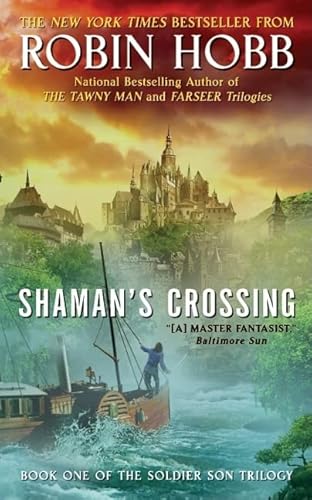
Shaman’s Crossing follows Nevare toward the King’s Cavalla Academy, where he trains to become an officer. His education exposes the tensions between old aristocratic families and the newer nobility created by Gernia’s territorial expansion. The academy initially appears to represent the structured future Nevare has always expected, but his life has already been disrupted by an encounter with the magic of the plains people.
That experience connects him to forces that challenge everything his culture has taught him. Gernia regards its expansion as progress, building roads and settlements while pushing its frontier deeper into territories occupied by other peoples. From another perspective, however, the same process is conquest. Hobb gradually forces Nevare to confront the difference between the patriotic story he has inherited and the consequences experienced by those standing in Gernia’s path.
The Specks, a forest people with powerful magic, become particularly important. Their worldview is radically different from Gernia’s emphasis on military order, technological development, property, and territorial control. Their magic does not fit neatly into the categories Nevare understands, and his connection to it increasingly makes his own body and identity a battleground between competing cultures.
Forest Mage pushes that conflict into much more personal territory. Nevare’s physical transformation alienates him from the society in which appearance, military fitness, family honor, and self-discipline carry enormous weight. The changes are not simply cosmetic or incidental to the plot. Hobb uses Nevare’s body to examine shame, prejudice, loss of social status, and the frightening experience of having one’s sense of self altered by forces that cannot be controlled through willpower.
By Renegade’s Magic, Nevare’s divided identity has become inseparable from the larger struggle between Gernian expansion and Speck magic. The assumptions that governed his childhood—about civilization, duty, family, and destiny—can no longer provide straightforward answers. The trilogy increasingly asks whether loyalty remains virtuous when the system demanding that loyalty is itself causing destruction.
The books should be read strictly in publication order. They form one continuous narrative, with Nevare’s psychological and physical development carrying directly from one volume into the next. Forest Mage depends heavily on the consequences of Shaman’s Crossing, while Renegade’s Magic completes conflicts established throughout both earlier novels.
Soldier Son is notably different in atmosphere from Hobb’s Realm of the Elderlings. There is no Fitz, Fool, Farseer dynasty, Skill, Wit, liveship, or shared Elderlings history. Its magic, geography, societies, and political conflicts belong entirely to their own setting.
What it shares with Hobb’s better-known work is her fascination with identity under pressure. Nevare begins with unusual certainty about who he is and what his life should become. Hobb then systematically dismantles that certainty, forcing him to experience his culture from perspectives he was raised to dismiss. The result is less a conventional military fantasy than an extended examination of colonialism, cultural conflict, bodily autonomy, duty, and the painful reconstruction of identity when the future promised at birth becomes impossible.