
Below is the complete list of Charles Finch’s Charles Lenox books in order. For this series, the chronological reading order is the same as the order of publication.
Publication Order of Charles Lenox Books


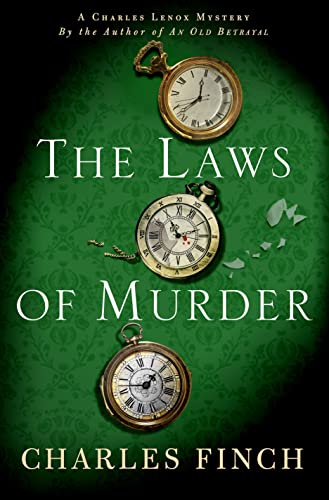


About Charles Lenox
Charles Finch’s Charles Lenox series is a historical mystery sequence set primarily in Victorian England and centered on an independently wealthy gentleman whose real passion is detective work. Beginning with A Beautiful Blue Death, the series combines traditional murder mysteries with political intrigue, domestic life, friendship, and the changing institutions of nineteenth-century Britain. Lenox develops considerably across the books, moving from an amateur investigator constrained by his social position toward a more established detective while also experiencing marriage, fatherhood, and a career in Parliament.
When A Beautiful Blue Death opens in 1865, Lenox lives comfortably in London and enjoys the privileges of the upper class. He could devote himself entirely to travel, books, clubs, and society, but solving crimes gives him a sense of purpose. Detective work is not considered an especially respectable occupation for a gentleman of his standing, and Scotland Yard is still developing as a professional institution, placing Lenox in an unusual position between privileged amateur and serious investigator.
The first case begins through his close friend and neighbor Lady Jane Grey, who asks Lenox to look into the suspicious death of a former servant. What appears to be suicide develops into a murder investigation involving poison and people with considerably more to hide than the initial circumstances suggest. The novel establishes Finch’s approach: careful detection is important, but understanding class, reputation, and social behavior can be equally valuable.
Lady Jane becomes central to Lenox’s personal story. Their relationship develops gradually from a deep existing friendship rather than functioning as a disposable romantic subplot. Lenox’s brother Edmund, physician Thomas McConnell, and other recurring characters likewise give the series a stable social world that continues changing between investigations.
Books including The September Society, The Fleet Street Murders, and A Stranger in Mayfair expand Lenox’s investigative experience while drawing him further into public life. His eventual involvement in Parliament adds another dimension to the series. Political responsibilities sometimes compete with detective work, and Finch uses Westminster to explore ambition, reform, influence, and the workings of Victorian government.
The cases also take Lenox beyond London. A Burial at Sea places him aboard a ship bound for Egypt, while other investigations move through country estates, universities, political circles, and different levels of British society. This variety allows Finch to explore Victorian institutions without abandoning the continuing relationships that anchor the series.
An unusual structural development occurs after The Woman in the Water. Rather than continuing immediately from the established chronology, Finch uses that novel and the following books The Vanishing Man and The Last Passenger to revisit Lenox as a younger investigator. These prequels show him building a professional reputation and developing methods that readers of the earlier-published novels have already seen him use with confidence.
The series then returns to the later chronology with The Last Enchantments—not to be confused with Finch’s unrelated contemporary novel of that title—No, this is precisely where careful distinction is necessary: The Last Enchantments is not a Charles Lenox mystery. The Lenox sequence resumes after the prequel trilogy with The Last Passenger followed in publication by An Extravagant Death, which returns to the mature Lenox and sends him to the United States. Subsequent books continue his later investigative career.
Because of the prequels, chronological order and publication order differ. Publication order is generally preferable. The early-published novels introduce Lenox, Lady Jane, his family, and his professional development as Finch originally constructed them. The later prequel trilogy is more effective when read with knowledge of the man Lenox eventually becomes.
Individual cases usually reach a complete resolution, but the personal continuity is substantial enough that the series benefits from sequential reading. Relationships change, marriages occur, careers develop, and Lenox’s understanding of detection evolves. Later novels can therefore reveal consequences of choices made several books earlier even when the current murder is independent.
What distinguishes Charles Lenox is the tension between privilege and vocation. Lenox begins with enough wealth and social standing that he never needs to work, yet he increasingly recognizes investigation as genuine work requiring discipline and responsibility. Finch uses that contradiction to develop both a detective and a portrait of Victorian society, following a man who can enter its most exclusive rooms while remaining fascinated by the secrets their occupants would prefer him not to uncover.