
Below is the complete list of William McIlvanney’s Jack Laidlaw books in order. For this series, the chronological reading order is the same as the order of publication.
Publication Order of Jack Laidlaw Books
with Ian Rankin


About Jack Laidlaw
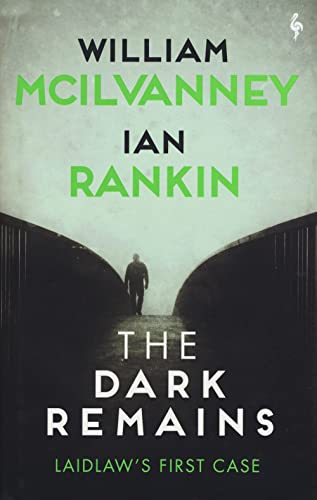
William McIlvanney’s Jack Laidlaw series is a landmark of Scottish crime fiction, following Detective Inspector Jack Laidlaw through murder investigations that expose the violence, class divisions, sectarian tensions, loyalties, and moral contradictions of Glasgow. The sequence began with Laidlaw in 1977 and continued with The Papers of Tony Veitch and Strange Loyalties. A fourth novel, The Dark Remains, was left unfinished when McIlvanney died in 2015 and was later completed by Ian Rankin from McIlvanney’s manuscript and notes. Although published last, it is a prequel set before the original trilogy.
Laidlaw begins with the murder of a young woman, Jennifer Lawson. The investigation sends Laidlaw through a Glasgow divided by neighborhood, religion, class, criminal influence, and competing notions of justice. McIlvanney is interested in finding the killer, but the conventional question of whodunit is only part of the novel. The murder becomes a route into the city and the social conditions surrounding both victim and perpetrator.
Laidlaw himself immediately distinguished the series from more conventional police procedurals. He is a detective with a philosophical temperament, carrying books by writers such as Kierkegaard and Camus while working streets where abstract ideas about morality encounter the practical realities of violence. He is intelligent, argumentative, compassionate, frequently difficult, and deeply aware that legality and justice do not always describe the same thing.
His partnership with Detective Constable Bob Lilley provides an important counterbalance. Lilley is more conventional and initially has difficulty understanding Laidlaw’s methods, but their relationship allows McIlvanney to expose the reasoning behind his protagonist’s seemingly eccentric behavior. Laidlaw does not merely collect evidence. He tries to understand the emotional and social pressures that make a crime possible.
The Papers of Tony Veitch begins with the death of a homeless alcoholic and develops into an investigation involving the disappearance of Tony Veitch. Apparently disconnected people and events gradually lead Laidlaw deeper into Glasgow’s criminal and political networks. The novel won the Crime Writers’ Association Silver Dagger and further established McIlvanney’s distinctive fusion of literary fiction and police investigation.
Strange Loyalties makes the investigation intensely personal. After the death of Laidlaw’s brother Scott, officially treated as an accident, Laidlaw becomes convinced that understanding how his brother died requires understanding the life that led him there. The novel consequently pushes beyond conventional detective fiction into grief, family, politics, masculinity, and the difficulty of assigning simple causes to human tragedy.
The Dark Remains returned readers to Laidlaw decades later. McIlvanney had begun another novel before his death but left it incomplete. With the cooperation of his estate, Ian Rankin used the surviving material to finish the book. Set before Laidlaw, it follows an investigation into the murder of lawyer Bobby Carter, whose connections to Glasgow’s criminal world threaten an unstable balance of power.
Because The Dark Remains is chronologically a prequel, readers have two reasonable approaches to the sequence. Chronological order places it first, but publication order—beginning with Laidlaw—provides the clearest introduction to McIlvanney’s original development of the character and preserves the historical evolution of the series.
The Jack Laidlaw books became foundational to what would later be called Tartan Noir. Their influence can be seen particularly clearly in Ian Rankin’s Inspector Rebus novels: both use a difficult, introspective detective to examine a Scottish city in which respectable institutions, poverty, politics, and criminal networks continually intersect.
What makes Laidlaw enduring is McIlvanney’s refusal to treat murder as an isolated puzzle. Catching the person responsible does not explain why violence occurred. Laidlaw wants to understand the individual, the victim, the city, and the conditions surrounding them—and it is that search for meaning beyond the solution of the crime that gives the series its distinctive place in Scottish literature.