
Below is the complete list of Brandon Sanderson’s Alcatraz books in order. For this series, the chronological reading order is the same as the order of publication.
Publication Order of Alcatraz Books


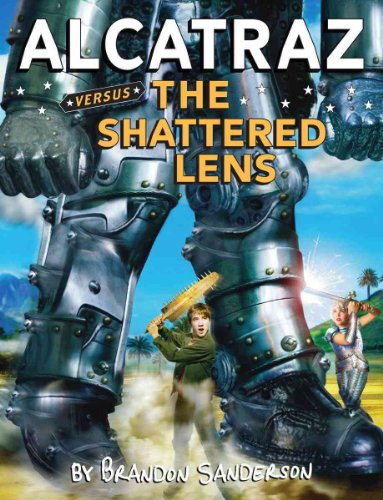


About Alcatraz
Brandon Sanderson’s Alcatraz series, formally titled Alcatraz vs. the Evil Librarians, is a six-book middle-grade fantasy saga that treats misinformation, secret history, magical technology, and family dysfunction as material for fast, self-aware comedy. The story begins with thirteen-year-old Alcatraz Smedry, a foster child convinced that his defining trait is his ability to break things. On his birthday he receives an inheritance consisting of a bag of sand, which is promptly stolen. The theft exposes a hidden conflict and forces him to reconsider almost everything he believes about his family and the world itself.
The central joke is also the foundation of the setting. The Evil Librarians are not merely unpleasant custodians of books; they are a powerful organization that controls much of the world Alcatraz knows, suppressing information and shaping accepted history. The supposedly ordinary nations under their influence are known as the Hushlands, while beyond them exist the Free Kingdoms, societies with technologies, political structures, and forms of knowledge concealed from most Hushlanders. Sanderson uses that reversal to play with the authority of textbooks, official narratives, and the assumption that familiar information must be true.
Alcatraz discovers that he belongs to the Smedry family, whose members possess magical Talents that sound more like personal defects than heroic abilities. Breaking things, arriving late, getting lost, or performing other apparently inconvenient acts can become powerful advantages when understood correctly. Alcatraz’s destructive Talent is therefore not simply comic clumsiness. Over the series, he learns that weaknesses and strengths are often matters of context, a theme Sanderson develops without abandoning the absurdity of the premise.
The other major magical system involves Oculators, who use specialized lenses with distinct abilities. This gives the series a recognizable Sandersonian interest in rule-based magic, but the tone differs sharply from Mistborn or The Stormlight Archive. Here, technical explanations coexist with jokes about writers, chapter structure, footnotes, unreliable narration, and the conventions of fantasy itself. Alcatraz frequently addresses the reader directly and insists that the books are autobiographical accounts disguised as fiction because Librarian-controlled society would otherwise suppress the truth.
Bastille provides an essential counterweight to him. A Knight of Crystallia charged with protecting members of the Smedry family, she is disciplined, capable, impatient, and often furious at Alcatraz’s behavior. Their relationship develops amid the wider conflict, while Grandpa Smedry and other relatives expand the saga into a story about a family whose eccentricities are inseparable from its powers. As the books move beyond the opening confrontation, the scope widens through places such as the Library of Alexandria, the Free Kingdoms, and Mokia, and the conflict becomes increasingly entangled with Alcatraz’s estranged parents.
The series grows darker beneath its comedy. Questions about truth, propaganda, heroism, responsibility, and the damage caused by supposedly noble plans become more prominent, particularly as Alcatraz learns that adults on multiple sides have withheld information from him. The Dark Talent pushes those tensions into a severe crisis and ends in a way that deliberately leaves the story unfinished.
That ending explains the most important structural wrinkle in the bibliography. The first five books were written by Sanderson and narrated through Alcatraz’s distinctive voice. The sixth and concluding novel, Bastille vs. the Evil Librarians, was written by Sanderson and Janci Patterson and shifts the narrative perspective to Bastille. Published in 2022 after a substantial gap, it completes the conflict left unresolved by the fifth book rather than beginning a separate spin-off.
Across the full saga, the apparent silliness is part of the design rather than a distraction from it. Sanderson builds a world where ridiculous Talents can be formidable, authoritative institutions can manufacture ignorance, and an unreliable teenage narrator may understand himself less clearly than the reader does. The result is one of his most playful series, but also one of his most direct examinations of who controls knowledge and why accepting the official version of reality can be dangerous.