
Below is the complete list of Louis L’Amour’s The Sacketts books in order. For this series, the chronological reading order is the same as the order of publication.
Publication Order of The Sacketts Books


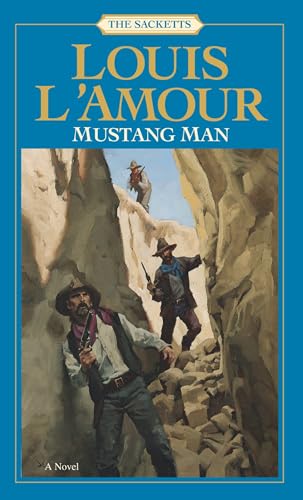


About The Sacketts
Louis L’Amour’s The Sacketts is a multigenerational frontier saga tracing one fictional family from Elizabethan England through colonial America and into the nineteenth-century West. The core series comprises seventeen novels spanning ten generations, although Sackett characters also appear in short stories and occasionally cross into L’Amour’s other fiction. Rather than constructing one continuous plot, L’Amour uses different members of the family to explore successive stages of settlement, migration, and westward expansion.
The saga actually began in the middle. The Daybreakers, published in 1960, introduced brothers Orrin and Tyrel Sackett as they leave Tennessee and head west after the Civil War. L’Amour subsequently enlarged their family history in both directions, eventually reaching back centuries to explain how the Sacketts arrived in America. This means the earliest events in the family chronology were written considerably later than some of the classic Western-era novels.
Sackett’s Land takes the family story back to Barnabas Sackett in 1599. Barnabas’s encounters with England’s class system, maritime danger, and the possibilities offered by America establish a recurring Sackett characteristic: a preference for independence over inherited privilege. To the Far Blue Mountains continues his attempt to establish a life in the New World, after which the focus shifts toward his sons and their descendants. The Warrior’s Path and Jubal Sackett broaden the geographical range considerably, showing the family pushing farther into an unfamiliar continent rather than remaining tied to one settlement.
The later Western generation contains the characters most strongly associated with the Sackett name. William Tell Sackett, Orrin, and Tyrel are brothers, but their personalities and paths differ markedly. Orrin gravitates toward law, politics, and public responsibility; Tyrel becomes famous as a formidable gunfighter despite having little interest in acquiring such a reputation; Tell is more solitary, moving through mining country, desert, cattle country, and remote settlements where trouble repeatedly finds him. Sackett places Tell firmly at the center of this era, while subsequent stories continue testing the family’s famous loyalty to one another.
Other relatives prevent the saga from becoming exclusively the story of those three brothers. Orlando “Lando” Sackett has his own turbulent history, while Nolan Sackett, Logan Sackett, and brothers Flagan and Galloway extend the clan into different corners of the West. Sixteen-year-old Echo Sackett, protagonist of Ride the River, is particularly notable because her adventure occurs before the classic 1870s period and places a young Sackett woman at the center of the family tradition of toughness and self-reliance.
Most of the saga’s familiar Western action is concentrated in twelve novels set around the 1870s, where mining claims, cattle drives, range wars, gunfighters, isolated settlements, and the uncertain reach of law provide the backdrop. The books remain largely self-contained adventures, but relatives reappear, earlier exploits become part of family reputation, and a threat against one Sackett can quickly draw others into the conflict.
L’Amour intended something even larger. The Sacketts were conceived alongside the Talons and Chantrys as part of an ambitious fictional history stretching from the 1590s into the late nineteenth century, and several planned Sackett stories were never written. What survives still achieves much of that purpose: instead of one legendary Western hero, the series presents generations of a family repeatedly moving toward new country, carrying an inherited belief that independence matters—but family loyalty matters just as much.