
Below is the complete list of Louis L’Amour’s Chantry books in order. For this series, the chronological reading order is the same as the order of publication.
Publication Order of Chantry Books


About Chantry
Louis L’Amour’s Chantry books form a loosely connected family saga rather than a conventional Western series following one hero from novel to novel. Different generations of the Chantry family appear across stories set centuries apart, allowing L’Amour to trace the same qualities—independence, education, courage, self-reliance, and a willingness to defend what is right—through changing periods of frontier history. The Chantrys also intersect with L’Amour’s better-known Sackett and Talon families, making them part of the wider network of recurring bloodlines that links otherwise stand-alone novels throughout his fictional West.
The family’s story reaches furthest back through Tatton Chantry in Fair Blows the Wind. An Irishman whose father is killed and home destroyed, Tatton leaves Ireland determined to rebuild his fortunes. His adventures carry him through Europe and eventually across the Atlantic to the New World, placing the Chantry name in America long before the traditional cattle-town era associated with most Western fiction. Tatton is also mentioned in To the Far Blue Mountains, creating an early connection between the Chantrys and Barnabas Sackett’s generation.
Ronan Chantry, the protagonist of The Ferguson Rifle, belongs to a later stage of the family history. Well educated but driven west by personal loss, Ronan travels beyond the Mississippi with a rare breech-loading Ferguson rifle and becomes caught in a search for buried treasure. The novel reflects L’Amour’s preference for frontier heroes who combine practical wilderness ability with knowledge gained from books, travel, and experience. Later material from L’Amour’s papers indicates that he envisioned additional episodes in the Chantry chronology around Ronan’s story, though those planned novels were never completed.
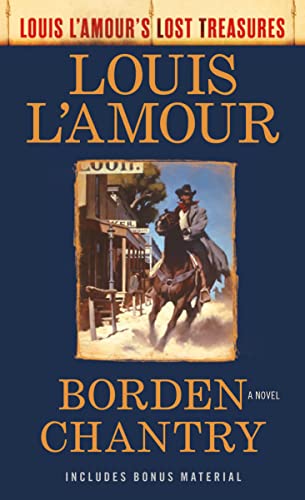
By the nineteenth-century Western period, the family appears through figures such as Owen Chantry and Borden Chantry. Owen enters Over on the Dry Side after returning to find his brother murdered and becoming involved in a violent struggle over supposed buried treasure. Borden represents another variation on the Chantry type: he is a town marshal rather than a wandering adventurer. In Borden Chantry, a series of murders forces him to investigate a killer operating within a community where he knows many of the people involved.
Borden also connects directly with L’Amour’s Sackett world. He appears alongside Tyrel Sackett in Son of a Wanted Man, where both lawmen are closing in on the criminal empire created by Ben Curry. That crossover demonstrates how L’Amour treated his recurring families as inhabitants of the same frontier rather than characters confined to isolated series.
The generational thread continues with Tom Chantry, Borden’s son, in North to the Rails. Tom comes west to buy cattle and initially avoids carrying a gun or settling disputes through violence. Driving a herd toward the railroad forces him to confront a harsher frontier than the business world he understands, making his story partly about proving that the Chantry inheritance consists of judgment and resilience rather than simply skill with a weapon.
The Chantry books therefore span a much wider historical range than their shared surname initially suggests. Their unity comes from family legacy rather than one continuous plot, with each generation adapting familiar Chantry qualities to a different frontier. Read alongside the Sackett and Talon novels, they also reveal how deliberately L’Amour connected separate Western adventures into a broader history of families moving across America.