
Below is the complete list of Jeff Shaara’s World War II: 1939-1945 books in order. For this series, the chronological reading order is the same as the order of publication.
Publication Order of World War II: 1939-1945 Books


About World War II: 1939-1945
Jeff Shaara’s World War II series is a trilogy of historical novels following the Allied campaign against Nazi Germany, from the fighting in North Africa through the liberation of Western Europe and the final defeat of the Third Reich. Consisting of The Rising Tide (2006), The Steel Wave (2008), and No Less Than Victory (2009), the series combines major military operations with the personal experiences of commanders and ordinary soldiers. Together, the novels provide a continuous account of the war in the European theater, told through fictionalized perspectives grounded in historical events.
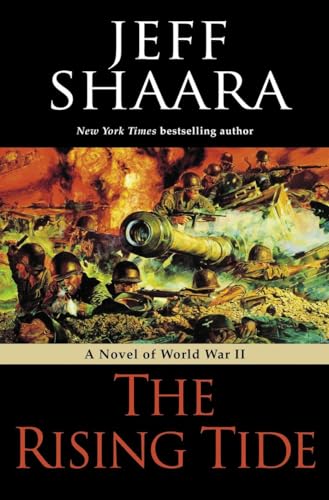
The trilogy begins with The Rising Tide, which explores the Allied struggle in North Africa and the subsequent invasion of Sicily and Italy. The novel opens during a period when the outcome of the war remains uncertain and Allied forces are still learning how to fight an experienced German military.
Among the prominent historical figures portrayed are Dwight D. Eisenhower, George S. Patton, Erwin Rommel, and Bernard Montgomery. Shaara uses their differing personalities and approaches to command to examine the difficulties of coordinating large military operations involving several nations.
The North African campaign provides an important starting point because it exposes weaknesses in Allied planning, leadership, and battlefield experience. American forces encounter a German army that has already spent years fighting in Europe and the Mediterranean. Success requires improvements in organization, cooperation, and tactical judgment, often achieved through costly mistakes.
Shaara also introduces fictional enlisted characters whose experiences provide a contrast to the decisions made at headquarters. Their perspectives bring the narrative closer to the battlefield, where orders become exhausting marches, artillery bombardments, casualties, and immediate questions of survival.
The Steel Wave shifts the principal focus to the planning and execution of the Normandy invasion in June 1944. Operation Overlord represents an enormous logistical and military undertaking, requiring Allied commanders to coordinate naval forces, aircraft, airborne troops, and ground formations while maintaining secrecy about the invasion’s intended location.
Eisenhower remains central to the strategic narrative, particularly as he confronts the responsibility of ordering an operation whose failure could have prolonged the war considerably. The novel also examines the roles of commanders such as Rommel, who must prepare German defenses while facing uncertainty about where the Allies will land.
The invasion itself is portrayed from several levels of command. Shaara moves between the strategic calculations of senior officers and the experiences of soldiers landing on heavily defended beaches. The contrast demonstrates how carefully developed plans can become chaotic once fighting begins.
Following Normandy, the Allied advance across France brings new challenges. Supply problems, difficult terrain, German resistance, and disagreements over strategy complicate the campaign. The liberation of territory does not automatically translate into a rapid end to the war.
The concluding No Less Than Victory begins during the final stages of the European conflict, including the German counteroffensive in the Ardennes that became known as the Battle of the Bulge. The unexpected attack temporarily disrupts Allied expectations and creates severe conditions for soldiers fighting through the winter of 1944–1945.
The novel follows the Allied recovery and advance into Germany as the Nazi regime approaches collapse. Shaara portrays the military and human consequences of the final campaign, including the devastation encountered by advancing forces and the growing recognition of the crimes committed under Nazi rule.
One of the trilogy’s defining features is its attention to command decisions. Eisenhower, Patton, Rommel, and other historical figures are not presented simply as names associated with famous battles. Shaara reconstructs the pressures surrounding their choices, including disagreements, incomplete intelligence, political constraints, and the consequences of misjudgment.
At the same time, the enlisted perspectives prevent the novels from becoming exclusively accounts of generals directing armies across maps. Ordinary soldiers experience the war through immediate dangers and personal relationships, often knowing little about the strategic objectives that determine their movements.
The series should be read in publication order, beginning with The Rising Tide, followed by The Steel Wave and No Less Than Victory. The chronological progression allows readers to follow the development of Allied operations and the changing balance of power in Europe.
Shaara has written other novels about World War II, including The Final Storm, which covers the Pacific campaign, and The Eagle’s Claw, which focuses on the Battle of Midway. These are separate works rather than additional numbered installments in the European-theater trilogy.
Although the books incorporate real historical figures and extensively researched military events, they remain works of historical fiction. Private conversations, thoughts, and certain individual experiences are reconstructed or invented to create a continuous narrative. Their purpose is not to replace documentary military history but to explore how participants might have experienced the decisions and events recorded in it.
The World War II trilogy reflects Shaara’s characteristic approach to military fiction: placing the reader at different levels of a conflict while preserving the broader historical sequence. From North Africa to Normandy and the final advance into Germany, the novels show how Allied victory emerged through years of difficult decisions, costly battles, and the combined efforts of commanders and soldiers.