
Below is the complete list of Eric Van Lustbader’s Pearl Saga books in order. For this series, the chronological reading order is the same as the order of publication.
Publication Order of Pearl Saga Books


About Pearl Saga
Eric Van Lustbader’s Pearl Saga is an ambitious fusion of epic fantasy and science fiction set on Kundala, a spiritually ordered world conquered by the technologically superior V’ornn. More than a century after the invasion, the native Kundalans live under occupation while their traditional faith in the goddess Miina weakens. The V’ornn treat the planet as a source of wealth and its people as an inferior species, yet their enigmatic rulers, the Gyrgon, privately covet Kundalan sorcery. They believe its sacred artifacts may hold the immortality that their own technomagic cannot provide.
The conflict begins in The Ring of Five Dragons, but the series is not structured as three separate adventures. It is one continuous narrative in which political upheaval, prophecy, religious crisis, and the search for powerful artifacts develop across every volume. Events in the opening book alter identities and relationships that remain essential thereafter, so publication order is necessary even when later editions summarize the background.
At the center is Riane, the prophesied Dar Sala-at, or redeemer. Her identity embodies the saga’s central opposition between cultures: she is a Kundalan young woman joined through sorcery with the mind and spirit of Annon Ashera, a V’ornn nobleman whose family is destroyed in a political coup. Their union creates someone who belongs wholly to neither people while carrying the memories, abilities, and obligations of both. Riane’s development is therefore more than a conventional chosen-one ascent. She must reconcile two histories inside one consciousness while deciding whether liberation can be achieved without reproducing the cruelty of conquest.
A large ensemble surrounds her. Giyan, a Kundalan sorceress and priestess, protects knowledge that may determine the planet’s future. Thigpen, a six-legged Rappa companion, adds wit but also possesses important cultural and magical understanding. Figures such as Eleana, Rekkk, Kurgan, and the renegade Gyrgon Sahor complicate any simple division between virtuous Kundalans and evil invaders. Loyalties change, oppressors become capable of transformation, and resistance fighters must confront the moral cost of vengeance.
Lustbader builds Kundala through competing religions, caste systems, invented languages, sacred texts, rituals, and technologies that frequently resemble magic. He drew part of the Kundalan social conception from ancient Crete and its goddess-centered culture, while giving language an unusually prominent role in names, dialects, prophecy, and belief. The result is dense rather than minimalist world-building. Readers are expected to absorb unfamiliar terminology and political relationships while the narrative moves between numerous viewpoints.
The Pearl itself and the artifacts connected to it provide the outward quest, but the deeper subject is power: who deserves it, whether spiritual authority is less corruptible than technological control, and how cultures change when occupation lasts for generations. Love, grief, identity, faith, and transformation become increasingly prominent, particularly in the third volume.
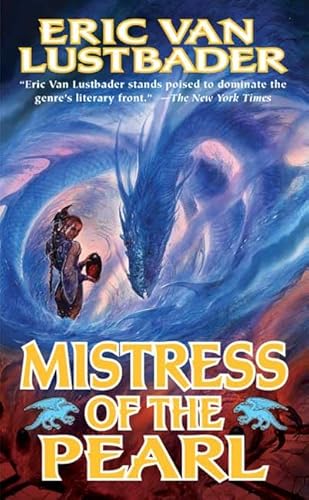
That third novel is commonly published as Mistress of the Pearl and has also appeared under the title The Cage of Nine Banestones. These are alternate titles for the same book, not separate installments. Only three volumes have been published, although the project was conceived as a larger multi-volume saga. The existing sequence therefore should be approached as an unfinished epic rather than a self-contained trilogy with every conflict resolved.