
Below is the complete list of Agatha Christie’s Harley Quin books in order. For this series, the chronological reading order is the same as the order of publication.
Publication Order of Harley Quin Books

Publication Order of Harley Quin Short Stories/Novellas Books
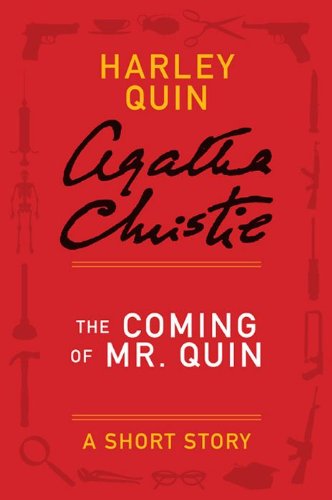




- The Harlequin Tea Set (1971)
In the Harley Quin series, The Harlequin Tea Set is book #14 and was published in 1971. 
About Harley Quin
Agatha Christie’s Harley Quin stories occupy a strange and fascinating place in her bibliography because they are not really detective fiction in the usual Poirot or Miss Marple sense. Quin is not a methodical investigator, a policeman, or a village observer with a gift for seeing through lies. He is something far more elusive. He appears suddenly, often in moments of emotional or moral crisis, and his role is less to solve a crime directly than to awaken understanding in someone else, usually Mr. Satterthwaite. That difference is the key to the series. These stories are mysteries, certainly, but they are also meditations on chance, love, regret, and the eerie sense that some truths arrive from just outside ordinary reason.
The center of the series is really the partnership between Harley Quin and Mr. Satterthwaite. Satterthwaite is an older man, socially observant, well connected, and usually more spectator than participant in life. He notices people, reads moods, and understands drama, but he does not always act. Quin changes that. Whenever he appears, something hidden begins to move toward revelation. Christie described Quin as associated with love and death, and that combination gives the stories their unusual tone. They are rarely about brute criminal investigation alone. More often they are about old choices, broken hearts, missed chances, and the way emotional truth can lie buried beneath the official version of events.
Publication order matters here less because of a strict ongoing plot and more because it lets the reader settle into the series’ peculiar atmosphere properly. The stories are collected most famously in The Mysterious Mr Quin, which remains the real center of the Harley Quin line. Beginning with “The Coming of Mr Quin,” the sequence introduces the almost supernatural logic of the series: Quin arrives, Satterthwaite begins to see more clearly, and what looked settled or accidental turns out to conceal passion, guilt, or long-suppressed truth. Read in order, the stories feel less like separate cases and more like variations on one haunting idea.
That idea is what makes the series so distinct within Christie’s work. Poirot believes in the little grey cells. Miss Marple believes in human nature repeating itself in familiar forms. Quin, by contrast, seems to belong to intuition, symbol, and emotional necessity. Christie never pins him down completely, and that is part of the achievement. He can be read as almost supernatural, as a theatrical embodiment of insight, or as the force that allows Satterthwaite to become more fully himself. The stories are stronger because they resist reducing him to a neat explanation.
Satterthwaite also becomes more important the more of the series you read. At first he may seem like the ordinary mind beside the extraordinary visitor, but gradually it becomes clear that the stories are as much about him as they are about Quin. Satterthwaite is a man who has spent much of life watching others, and Quin repeatedly draws him toward moments where watching is no longer enough. In that sense, these stories are not only mystery tales. They are also about belated perception, about a man realizing that understanding human drama carries a moral cost if one never chooses to act.
For readers who already have the list above, the best way to think about the Harley Quin books is as Christie’s most atmospheric and least conventional recurring mystery sequence. This is not the place to come for classic detective mechanics alone. It is the place to see Christie working in a more mysterious, almost symbolic register, where crime is bound up with romance, memory, and the strange possibility that truth sometimes enters a room in the shape of a man no one can quite explain.