
Below is the complete list of Amanda Flower’s Magical Bookshop Mysteries books in order. For this series, the chronological reading order is the same as the order of publication.
Publication Order of Magical Bookshop Mysteries Books

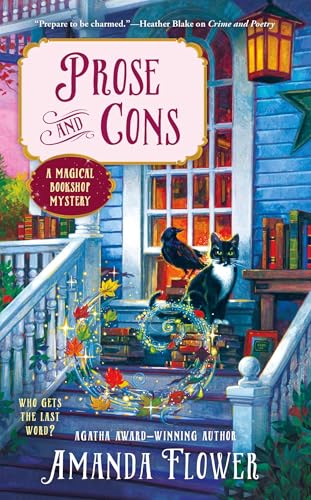


About Magical Bookshop Mysteries
Amanda Flower’s Magical Bookshop Mysteries blend cozy crime with paranormal fantasy in the small town of Cascade Springs, New York. The series follows Violet Waverly, a young woman who returns to her hometown and becomes the caretaker of Charming Books, a seemingly enchanted bookstore belonging to her family. Beginning with Crime and Poetry, the novels combine traditional murder investigations with literary clues, family secrets, romance, and a magical shop that appears to know exactly which book its customers—or its owner—need.
Violet initially has little desire to return to Cascade Springs. She left the town after a painful personal experience and built an academic life elsewhere, but a message concerning her grandmother Daisy draws her home. Once there, Violet discovers that Daisy’s supposed emergency was largely a way to persuade her to return. More surprising is the revelation that Violet has inherited responsibilities connected to Charming Books and the magical heritage of the Waverly family.
The bookstore is unlike an ordinary independent bookshop. Charming Books seems almost alive, with books moving, appearing, or drawing Violet’s attention without conventional explanation. A birch tree growing within the shop is tied to its unusual power, and the store communicates largely through literature. When Violet faces a problem, a particular book, quotation, poem, or passage may appear at precisely the right moment.
That device gives the mysteries their distinctive structure. The shop does not simply reveal the murderer. Instead, it provides literary clues that Violet must interpret, often forcing her to think about why a particular author, character, or passage has been placed in her path. Classic literature consequently becomes part of the detective work rather than merely decorating the bookstore setting.
In Crime and Poetry, Violet’s return home becomes a murder investigation when a man connected to Daisy is found dead near the shop. Circumstances place suspicion dangerously close to Violet’s grandmother, giving Violet an immediate reason to investigate. The case also introduces Chief David Rainwater, the local police officer whose relationship with Violet develops gradually across the series.
David provides a useful counterweight to the supernatural elements. He investigates crimes professionally and approaches evidence through ordinary police methods, while Violet has access to information supplied indirectly by Charming Books. Their different approaches can create tension, particularly because Violet cannot always explain how she arrived at a particular suspicion without revealing family secrets that would sound impossible to anyone unfamiliar with the shop.
Cascade Springs contributes the familiar social structure of a cozy mystery. Local businesses, residents, visitors, and community events repeatedly bring suspects together, while Violet’s family history means she is connected to the town even after spending years away. Returning home requires her not only to solve murders but also to reconsider the relationships and memories that led her to leave.
Daisy remains an important presence throughout the books. She understands far more about the Waverly family’s magical responsibilities than Violet does when the series begins and gradually helps her granddaughter accept a role she never expected to inherit. The generational relationship gives the supernatural premise an emotional foundation: the bookstore is not simply a magical object but part of a family legacy.
The series incorporates literature in increasingly playful ways. Mysteries can draw upon poetry, classic novels, children’s stories, and other recognizable works, with Charming Books selecting texts that connect thematically or symbolically to a current investigation. Violet’s academic background makes her particularly well suited to deciphering these clues, though understanding what the shop wants her to notice is rarely straightforward.
Publication order is the best way to read the Magical Bookshop Mysteries. Individual murders are resolved within their respective novels, but Violet’s understanding of Charming Books, her relationship with Daisy, her connection with David, and the mythology surrounding the Waverly family develop across the series. Later installments assume an increasing familiarity with how the magical bookstore operates.
What distinguishes the series within Flower’s broader mystery bibliography is that books themselves become investigative partners. Charming Books never makes Violet’s job easy enough to eliminate the mystery; it nudges her toward ideas, authors, and passages that she must interpret for herself. The result is a cozy series in which reading is not merely the theme surrounding the detective story—it is one of the tools through which the mystery can be solved.