
Below is the complete list of Rex Stout’s Nero Wolfe books in order. For this series, the chronological reading order is the same as the order of publication.
Publication Order of Nero Wolfe Books




















Publication Order of Nero Wolfe Short Stories/Novellas Books
- Bitter End (1997)
Published in 1997, Bitter End is listed as book #2 in the Nero Wolfe Short Stories/Novellas series. - Booby Trap (2013)
Booby Trap is a 2013 release and appears as book #3 in the Nero Wolfe Short Stories/Novellas series. - Cordially Invited to Meet Death (2014)
In the Nero Wolfe Short Stories/Novellas series, Cordially Invited to Meet Death is book #4 and was published in 2014. 

About Nero Wolfe
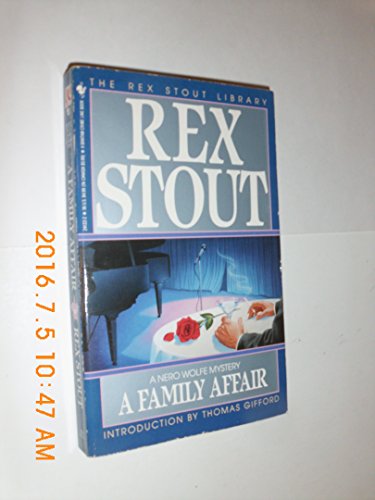
Rex Stout’s Nero Wolfe series is one of the defining bodies of American detective fiction, built around the unlikely partnership of brilliant private detective Nero Wolfe and his energetic assistant Archie Goodwin. Beginning with Fer-de-Lance in 1934 and continuing through A Family Affair in 1975, the original canon comprises 33 novels and 41 shorter works. Together they create an unusually stable fictional world centered on Wolfe’s Manhattan brownstone, where murder investigations repeatedly intrude upon a life he would prefer to devote to orchids, fine food, books, and beer.
Wolfe is an investigator who dislikes investigation in its physical sense. He is extraordinarily reluctant to leave his home, maintains an inflexible daily schedule, and spends hours tending orchids in rooftop plant rooms with Theodore Horstmann. Meals prepared by his Swiss chef, Fritz Brenner, are treated with similar seriousness. Wolfe accepts cases because maintaining this expensive household requires substantial fees, not because he has any desire for adventure.
Archie Goodwin makes Wolfe’s method possible. As Wolfe’s confidential assistant, investigator, secretary, and narrator, Archie performs most of the work outside the brownstone. He interviews witnesses, follows suspects, gathers information, provokes reactions, deals with clients, and remembers conversations with near-verbatim accuracy. He is witty, observant, socially confident, and considerably more comfortable with physical danger than his employer.
The contrast creates the series’ distinctive structure. Archie brings the evidence home; Wolfe examines it, identifies contradictions, and eventually constructs a solution. Important confrontations often culminate with suspects assembled in Wolfe’s office while he explains the crime. Yet the books are not simply exercises in armchair deduction. Archie’s investigations give them the movement, slang, humor, and urban texture associated with American private-eye fiction.
Fer-de-Lance establishes many of these conventions immediately. Wolfe and Archie investigate a disappearance that develops into a murder case involving a seemingly inexplicable death on a golf course. Subsequent novels such as The League of Frightened Men, The Rubber Band, and The Red Box strengthen the formula while expanding the circle of recurring characters.
Among the most important is Inspector Cramer of Manhattan Homicide. Cramer frequently resents Wolfe’s secrecy and unconventional methods but recognizes his abilities, creating a relationship built on irritation, competition, and reluctant respect. Sergeant Purley Stebbins is less tolerant of Archie, while freelance detective Saul Panzer becomes Wolfe’s preferred outside operative when additional investigative help is required.
Although the basic household remains remarkably unchanged, Stout was willing to disrupt it when a story demanded greater stakes. In the Best Families, for example, forces Wolfe into an extraordinary confrontation with criminal mastermind Arnold Zeck and temporarily overturns the familiar brownstone routine. Other novels engage with politics, business, wartime concerns, organized crime, broadcasting, publishing, and social controversies contemporary to their publication.
The shorter Nero Wolfe mysteries are an important part of the canon rather than incidental additions. Many were originally published in magazines before being collected in volumes containing two, three, or four novellas. Consequently, a complete reading order can look complicated when individual stories and the collections containing them are both listed.
Stout allowed contemporary references to change while Wolfe and Archie aged very little. This flexible chronology means the books are usually best approached in publication order rather than as a strict year-by-year biography of the characters. Most cases stand independently, but publication order preserves recurring relationships and occasional references to earlier investigations.
Stout’s final Wolfe novel, A Family Affair, gives the familiar world an unusually personal and somber test. After Stout’s death, other writers produced authorized continuations, most notably Robert Goldsborough, but those works are separate from the original Rex Stout canon.
Across four decades, the essential pleasure of Nero Wolfe remains remarkably consistent: Archie goes out into New York and brings its disorder home, while Wolfe sits behind his desk and turns that disorder into a solution.