
Below is the complete list of Joel C. Rosenberg books in order. For each series, the chronological reading order is the same as the order of publication.
Publication Order of The Last Jihad Books


Publication Order of David Shirazi Books


Publication Order of J. B. Collins Books


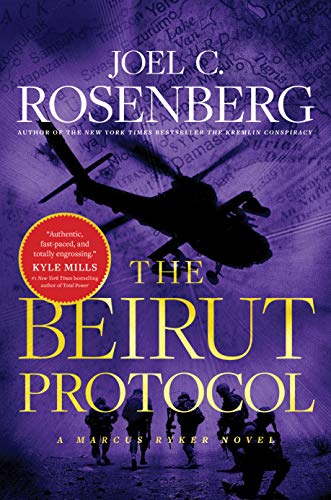
Publication Order of Marcus Ryker Books




Publication Order of Standalone Books

Publication Order of Non-Fiction Books


About Joel C. Rosenberg
Joel C. Rosenberg is an American-Israeli novelist, nonfiction writer, Middle East analyst, and media executive best known for geopolitical thrillers that combine espionage, terrorism, international diplomacy, and biblical prophecy. His fiction often begins with a plausible political crisis—a war, assassination, nuclear threat, terrorist conspiracy, or collapse of regional alliances—and follows officials, intelligence operatives, journalists, and civilians attempting to prevent catastrophe. He has written multiple bestselling series as well as nonfiction examining Israel, the Middle East, evangelical Christianity, and global security.
Born in Syracuse, New York, in 1967, Rosenberg grew up in the United States and graduated from Syracuse University. Before publishing fiction, he worked as a communications strategist with political and public figures in the United States and Israel. His professional associations included Steve Forbes, Jack Kemp, William Bennett, Benjamin Netanyahu, and Natan Sharansky. This experience gave him close familiarity with political messaging, election campaigns, policy debates, and the personalities operating around national leadership.
Rosenberg made his fiction debut with The Last Jihad in 2002. The novel introduced political strategist Jon Bennett and senior CIA operative Erin McCoy as the United States confronts terrorism, regional instability, and the possibility of a wider Middle Eastern war. It launched a connected sequence that includes The Last Days, The Ezekiel Option, The Copper Scroll, and Dead Heat. The books established the qualities that would remain central to Rosenberg’s fiction: rapid geopolitical escalation, detailed intelligence operations, evangelical belief, and speculation about how biblical prophecy might intersect with contemporary events.
The David Shirazi trilogy shifts attention toward Iran and the threat of a nuclear confrontation. Its protagonist is a CIA operative of Iranian heritage whose assignments place him inside conflicts involving political extremism, covert intelligence, and personal faith. Rosenberg later created New York Times correspondent J. B. Collins for a series concerned with terrorism, Middle Eastern alliances, and attacks directed at political leaders. The Marcus Ryker novels follow a former U.S. Secret Service agent drawn into crises involving Russia, North Korea, Iran, Lebanon, and China, giving Rosenberg another vehicle for examining conflicts capable of expanding into global war.
His standalone historical novel The Auschwitz Escape departs from the modern political-thriller framework. Set during the Holocaust, it follows prisoners attempting to escape Auschwitz and bring evidence of the camp’s atrocities to the outside world. The novel retains Rosenberg’s emphasis on danger, moral courage, and urgent action while grounding its conflict in documented historical events.
Rosenberg’s nonfiction includes Epicenter, Inside the Revolution, Implosion, The Invested Life, and Enemies and Allies. These books combine political analysis, interviews, travel, personal testimony, and his evangelical interpretation of events in Israel and the wider Middle East. His fiction and nonfiction are closely related, but they serve different purposes: the novels dramatize possible crises, while the nonfiction states his political and theological conclusions directly.
In 2014, Rosenberg became a dual citizen of the United States and Israel and settled in Jerusalem with his family. He founded The Joshua Fund, an evangelical nonprofit supporting humanitarian and Christian initiatives in Israel and neighboring countries. He later co-founded Near East Media and became editor-in-chief of ALL ISRAEL NEWS and ALL ARAB NEWS.
Rosenberg’s bibliography is best understood through its separate protagonists and geopolitical periods. What connects the books is his conviction that political decisions, religious ideas, and individual acts of courage can alter history with extraordinary speed.