
Below is the complete list of Mary Balogh’s Mistress books in order. For this series, the chronological reading order is the same as the order of publication.
Publication Order of Mistress Books


About Mistress
Mary Balogh’s Mistress series is a three-book Regency romance sequence built around unconventional relationships, social scandal, and characters whose public identities conceal far more complicated private lives. The trilogy consists of More than a Mistress, No Man’s Mistress, and The Secret Mistress. Although each novel centers on a different couple, the books are connected through the Dudley family and their wider social circle, with recurring characters carrying emotional and familial continuity from one story to the next.
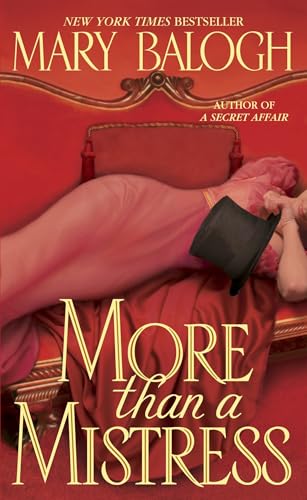
More than a Mistress introduces Jocelyn Dudley, Duke of Tresham, a powerful aristocrat accustomed to control, and Jane Ingleby, a woman living under circumstances that force her to conceal part of her identity. Their relationship begins with a sharp clash rather than conventional courtship. Jane becomes involved in Jocelyn’s household and gradually challenges both his assumptions about class and the emotional distance he maintains from the people around him. Balogh uses their unequal social positions to explore power, pride, vulnerability, and the difference between possession and genuine intimacy.
The second novel, No Man’s Mistress, shifts attention to Jocelyn’s younger brother, Lord Ferdinand Dudley. Ferdinand’s story begins with Viola Thornhill, a woman whose quiet country life is disrupted when he arrives claiming ownership of the property she considers her home. The resulting dispute quickly becomes more personal, but Viola’s past makes straightforward romance impossible. Her history is tied to a former life that respectable society would condemn, giving the title its particular force.
Viola’s story allows Balogh to examine shame and social judgment more directly than in many of her aristocratic romances. Her past cannot simply be erased once Ferdinand falls in love with her. The relationship must instead accommodate the reality of who she has been and the damage created by circumstances beyond easy social forgiveness. Ferdinand, meanwhile, is forced to reconsider assumptions about respectability and worth that his privileged upbringing has allowed him to take for granted.
The Secret Mistress turns to Lady Angeline Dudley, Jocelyn and Ferdinand’s sister, and chronologically functions as a prequel even though it was published last. Angeline is younger and more openly romantic than her brothers, but Balogh avoids making her story merely lighter or simpler. Her attraction to Edward Ailsbury, Earl of Heyward, brings together two people whose personalities seem almost deliberately mismatched. Angeline is exuberant, impulsive, and socially bold; Edward is restrained, serious, and far less comfortable with the theatrical conventions of fashionable society.
Because The Secret Mistress takes place before the first two novels, it also gives readers an earlier view of the Dudley family before Jocelyn and Ferdinand undergo the changes that define their own romances. That retrospective placement adds interest for readers already familiar with them, while Angeline’s story remains complete in its own right.
The trilogy’s strongest continuity comes from the Dudleys themselves. Jocelyn, Ferdinand, and Angeline are very different, but all three are accustomed to a social world in which rank, reputation, and appearance carry enormous weight. Each romance disrupts those assumptions in a different way. Jane challenges the boundaries of class and control, Viola forces confrontation with sexual reputation and social hypocrisy, and Angeline discovers that compatibility may have little to do with choosing the most dazzling person in the room.
Taken together, the Mistress books form a compact family series about aristocrats learning that intimacy requires more than status or desire. Balogh repeatedly strips away the roles her characters perform for society and asks what remains when pride, scandal, and expectation no longer provide a reliable guide to whom they should love.