
Below is the complete list of Mary Balogh’s Dark Angel books in order. For this series, the chronological reading order is the same as the order of publication.
Publication Order of Dark Angel Books


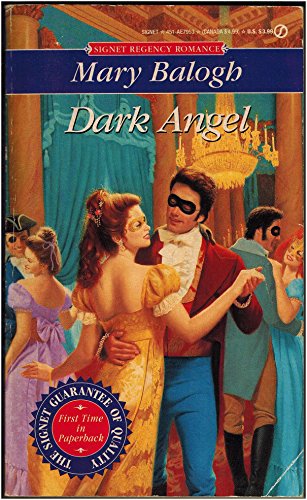


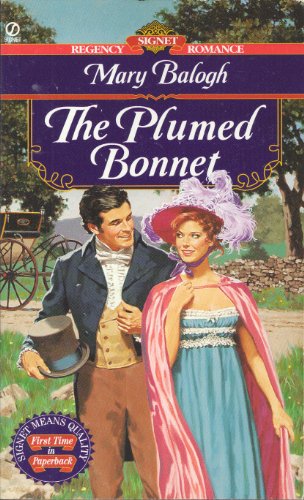

About Dark Angel
Mary Balogh’s Dark Angel series is a closely linked group of Regency romances built around cousins, friends, and acquaintances whose relationships overlap from one book to the next. The sequence begins with Dark Angel and continues through Lord Carew’s Bride, The Famous Heroine, The Plumed Bonnet, and A Christmas Bride. Balogh herself groups these five books together, and the connections among their characters are substantial enough that the series feels like one social world rather than a collection of unrelated romances.
Dark Angel introduces Jennifer Winwood and her cousin Samantha Newman during their London Season. Jennifer expects to marry Lionel, Viscount Kersey, whom she has loved for years, but the arrival of Gabriel, Earl of Thornhill, unsettles that assumption. Gabriel has returned to England after a scandal that damaged his reputation, and his hostility toward Lionel gives him motives that initially have little to do with romance. The resulting triangle establishes one of the series’ central concerns: the difference between what characters think they want and what they discover when pride, revenge, and long-held expectations are stripped away.
Samantha moves into the foreground in Lord Carew’s Bride. Her story takes a quieter emotional direction, centering on Harold, Lord Carew, a wealthy but physically disabled nobleman whose manner and circumstances contrast sharply with the more flamboyant figures around him. Balogh uses their relationship to examine attraction, self-consciousness, and the assumptions people make based on outward appearance. Because Jennifer and Samantha remain connected, the second book feels like a natural continuation of the same circle rather than a fresh start.
The series then broadens through secondary characters who become protagonists in their own right. The Famous Heroine follows Cora Downes, a wealthy merchant’s daughter whose attempt to save a young aristocratic child earns her unexpected entry into fashionable society. Her lack of polish places her in sharp contrast with the refined world around her, while her relationship with Lord Francis Kneller develops through humor, embarrassment, and gradually shifting expectations.
The Plumed Bonnet gives another supporting figure a central story. Stephanie Gray is found in unusual circumstances by Alistair Munro, Duke of Bridgwater, and their relationship begins with mistaken assumptions before developing into something more complicated. As elsewhere in the series, Balogh is less interested in preserving a glamorous first impression than in exposing the vulnerabilities hidden beneath social roles.
A Christmas Bride closes the sequence with Helena Stapleton and Edgar Downes, linking the Dark Angel books to Balogh’s related Ideal Wife/Precious Jewel world as well. The crossover is important because Balogh often built her Regency romances through overlapping families and acquaintances rather than rigidly isolated series.
The Dark Angel books are therefore best understood as a chain of connected romances in which one couple’s supporting characters become the emotional center of the next story. Social reputation, class, physical appearance, wealth, pride, and mistaken judgment recur throughout, but each romance approaches those themes differently.
What gives the series its cohesion is not a single plot but the gradual widening of a social circle. Jennifer and Samantha open the door, and Balogh then follows the people around them into stories of their own, creating a compact Regency world in which first impressions are rarely reliable and romantic happiness often requires characters to abandon the roles they thought they were supposed to play.