
Below is the complete list of Kyla Stone’s Lost Light books in order. For this series, the chronological reading order is the same as the order of publication.
Publication Order of Lost Light Books


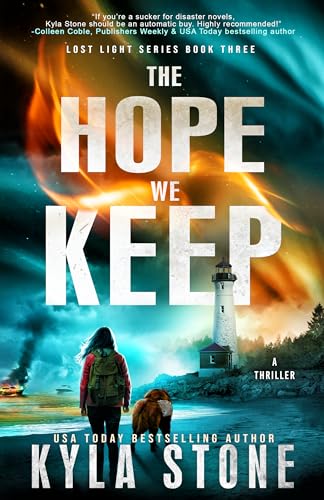

About Lost Light
Kyla Stone’s Lost Light series is a four-book post-apocalyptic survival saga built around the destruction of America’s electrical grid and the struggle to keep a family together after modern infrastructure fails. Beginning with The Light We Lost, the series follows Jackson Cross and his daughters, eighteen-year-old Shiloh and sixteen-year-old Lena, as a catastrophic solar event transforms an ordinary family crisis into a fight for survival. Stone keeps the scale of the disaster large while making its consequences intensely personal: the Cross family is already fractured before the lights go out.
Jackson is a former Marine who has spent years preparing for the possibility of catastrophe. His isolated homestead in rural Michigan is stocked and organized with survival in mind, giving him advantages that most people lack once electricity, communications, transportation, and supply networks begin failing. Preparation, however, cannot solve his most immediate problem. His daughters are away from home when the disaster strikes, forcing Jackson to leave the relative security he has created and enter an increasingly unstable world to find them.
Shiloh and Lena face the collapse from a very different position. Separated from their father and without access to his carefully accumulated supplies, they must adapt to a society changing by the hour. The loss of the grid quickly turns commonplace necessities into scarce resources. Vehicles become unreliable, stores cannot replenish food, communication disappears, medical assistance becomes uncertain, and people who initially expect services to return begin realizing that no quick recovery is coming.
The Cross family’s history gives those practical dangers additional weight. Jackson’s relationship with his daughters was already strained, and survival does not instantly repair the emotional distance between them. Stone uses the catastrophe to force characters who carry resentment, grief, and distrust into situations where cooperation may determine whether they live. The result is not simply a story about a prepared father teaching inexperienced teenagers how to survive; Shiloh and Lena develop their own judgment and resilience as the crisis progresses.
Human behavior becomes increasingly dangerous once the initial shock passes. Scarcity encourages theft, violence, and competition over food, fuel, medicine, weapons, and defensible shelter. Some survivors form communities for mutual protection, while others discover that the disappearance of effective law enforcement gives them opportunities to control or exploit people around them. Jackson’s military experience can help him recognize threats, but it cannot guarantee that every stranger can be classified neatly as ally or enemy.
Michigan provides an important physical framework for the series. Rural roads, forests, small communities, severe weather, and the distances separating people become much more consequential when powered transportation and instant communication can no longer be assumed. A journey that once required little planning can become a major expedition, while an isolated property may offer security at the cost of being far from assistance.
As the four books progress, the emphasis naturally widens beyond surviving the first days of the blackout. Long-term questions become unavoidable: how communities will obtain food, establish security, care for vulnerable people, and create workable rules when the systems that previously performed those functions are gone. Stone is particularly interested in the difference between being prepared for an emergency and being prepared for a permanently altered society.
Lost Light shares some territory with Stone’s Edge of Collapse books, particularly its interest in grid failure, family survival, and community resilience, but it is a separate series with its own characters and storyline. Its distinctive center is the Cross family. The disappearance of electricity creates the external catastrophe; the harder journey involves a father and his daughters confronting what was already damaged between them and deciding whether the end of their old world can become the beginning of a stronger family.