
Below is the complete list of Kyla Stone’s Nuclear Dawn books in order. For this series, the chronological reading order is the same as the order of publication.
Publication Order of Nuclear Dawn Books
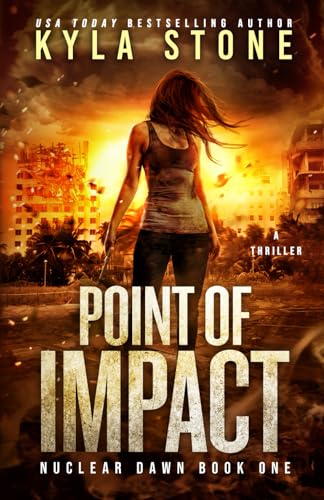


About Nuclear Dawn
Kyla Stone’s Nuclear Dawn series is a post-apocalyptic survival saga that follows several interconnected characters after coordinated nuclear attacks devastate major American cities. Beginning with Nuclear Dawn, the sequence concentrates not simply on surviving the explosions themselves but on the far more complicated aftermath: radiation, disrupted communications, crippled transportation, shortages of food and medicine, civil disorder, and the enormous difficulty of reaching loved ones when the systems connecting the country have broken down.
Dakota Sloane is one of the central figures in the series. A young woman carrying the effects of a difficult past, she is separated from the people who matter to her when nuclear catastrophe strikes. Her immediate objective becomes getting home, but ordinary travel has effectively ceased to exist. Roads, vehicles, communications, emergency services, and sources of reliable information can no longer be taken for granted, turning movement across the country into a survival challenge in its own right.
The series develops through multiple perspectives rather than restricting the catastrophe to Dakota’s experience. Among the important characters is Logan Garcia, whose own circumstances become increasingly connected to the larger struggle for survival. Stone uses these separate viewpoints to show how differently the same national disaster affects people depending on where they were when the attacks occurred, what resources they possess, and whether they have anyone trustworthy beside them.
Radiation distinguishes Nuclear Dawn from many grid-down survival stories. Escaping an immediate blast zone does not mean the danger has passed. Fallout can make apparently safe routes lethal, contaminated areas complicate access to food and water, and survivors frequently have incomplete information about which places remain habitable. Decisions about when to shelter, when to move, and which direction to travel can therefore be as consequential as confrontations with other people.
Stone also emphasizes how quickly secondary consequences multiply. Hospitals and emergency responders face overwhelming demand precisely when infrastructure is failing. Fuel becomes difficult to obtain, electronic communication disappears or becomes unreliable, supply chains stop functioning, and frightened populations begin competing for whatever necessities remain. The disaster evolves from a series of nuclear detonations into a nationwide struggle with cascading failures.
As in Stone’s other post-apocalyptic fiction, human behavior becomes another major source of danger. Some survivors cooperate, share resources, and attempt to preserve a functioning community; others exploit the absence of effective authority. Violence and coercion become increasingly plausible as scarcity deepens. The characters must therefore judge strangers constantly, knowing that refusing help can be deadly but trusting the wrong person can be worse.
Family and personal loyalty give the series its emotional structure. The characters are not trying to survive merely for the abstract goal of remaining alive. Separation creates reasons to travel when sheltering might be safer, while uncertainty about loved ones forces them to continue without knowing what they will find at the end of the journey. Stone repeatedly places practical survival calculations against these emotional obligations.
The Nuclear Dawn books form a closely connected narrative rather than a collection of unrelated adventures set after the same catastrophe. Consequences carry forward, relationships develop, and the characters’ priorities change as immediate survival gives way to questions about longer-term security and what remains of organized society.
Within Kyla Stone’s broader body of survival fiction, Nuclear Dawn is distinguished by the particular demands of nuclear catastrophe. The attacks happen quickly, but their consequences cannot be escaped simply by restoring electricity or reaching an isolated refuge. Radiation, displacement, scarcity, and the collapse of essential systems continue reshaping the characters’ world, making survival a continuing process of adaptation rather than a single escape from disaster.