
Below is the complete list of Kate Carlisle’s Fixer-Upper Mystery books in order. For this series, the chronological reading order is the same as the order of publication.
Publication Order of Fixer-Upper Mystery Books


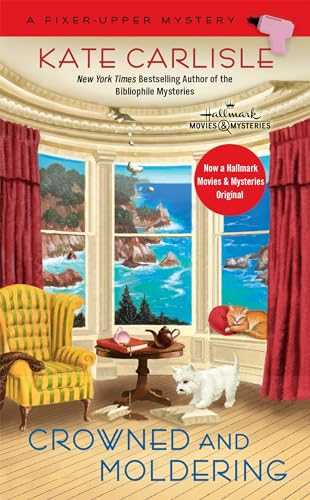


About Fixer-Upper Mystery
Kate Carlisle’s Fixer-Upper Mysteries combine cozy crime with home renovation, architectural history, and the secrets hidden inside old houses. Beginning with This Old Homicide in 2015, the series follows Shannon Hammer, a building contractor in the fictional Northern California town of Lighthouse Cove. Shannon specializes in restoring Victorian homes, a profession that regularly puts her inside properties with complicated histories—and occasionally brings her face-to-face with evidence of crimes their owners would prefer to keep concealed.
Shannon grew up around construction and learned the trade from her father, who founded Hammer Construction Company. She eventually takes charge of the family business and develops a reputation as a skilled contractor capable of restoring historic buildings without stripping away their character. Carlisle makes Shannon’s profession an important part of the mysteries rather than simply giving her an unusual occupation. Renovations involve opening walls, lifting floors, entering neglected rooms, and examining structures that may not have been disturbed for decades, creating natural opportunities for discoveries.
The first book, This Old Homicide, establishes both Lighthouse Cove and Shannon’s circle of friends. When Shannon’s neighbor Jesse Hennessey is found dead, what initially appears to be a natural death becomes increasingly suspicious. Shannon and her friends begin asking questions, introducing the mixture of friendship, community gossip, practical investigation, and danger that continues through the series.
Lighthouse Cove is central to the books’ identity. Located on the Northern California coast, it is filled with historic houses and residents whose connections frequently stretch back years. The setting gives Carlisle the intimacy expected from a cozy mystery while allowing construction projects to provide a changing backdrop. One book might involve an old Victorian house, another a hotel, mansion, or other property whose renovation exposes something unexpected.
Shannon’s expertise frequently affects how she interprets a crime scene. She understands tools, building materials, structural alterations, hidden spaces, and the practical realities of construction. Something that appears insignificant to another observer may immediately look wrong to an experienced contractor. The mysteries therefore grow naturally from her professional life rather than relying entirely on coincidence to place her near another investigation.
A major continuing relationship develops between Shannon and Mac Sullivan, a bestselling thriller writer who becomes part of her life early in the series. Their romance progresses across the books instead of returning to the same starting point after every murder. Mac also understands Shannon’s curiosity and tendency to become involved in investigations, even when following a clue creates considerably more danger than either of them anticipated.
Shannon’s close group of female friends provides another layer of continuity. Lighthouse Cove is presented as a genuine community, with friendships, professional relationships, romances, and local rivalries developing alongside the individual murder cases. These recurring characters give the books much of their warmth and humor while also providing plausible connections to the victims and suspects who enter Shannon’s orbit.
Carlisle makes effective thematic use of restoration. Historic houses preserve evidence of earlier lives: renovations can uncover concealed rooms, forgotten possessions, old documents, valuables, or physical traces of something deliberately hidden. That idea parallels the mysteries themselves. Shannon begins with a visible problem and gradually removes layers until she understands what happened beneath the surface.
The series expands naturally after This Old Homicide. Titles such as This Old Homicide, Deck the Hallways, A High-End Finish, Eaves of Destruction, and later installments continue the combination of construction terminology and murder, although the renovation theme never overwhelms the investigation. Carlisle provides enough detail to make Shannon credible as a contractor without turning the novels into technical manuals.
The Fixer-Upper Mysteries also inspired a series of television adaptations for Hallmark Movies & Mysteries. Jewel Kilcher portrayed Shannon Hammer and Colin Ferguson played Mac Sullivan in Framed for Murder: A Fixer Upper Mystery, Concrete Evidence: A Fixer Upper Mystery, and Deadly Deed: A Fixer Upper Mystery. The films draw from Carlisle’s fictional world while making changes typical of screen adaptations.
Most individual mysteries can be read independently because the central crime is resolved within each installment. Publication order is nevertheless preferable. Shannon’s relationship with Mac, developments among her friends, and changes in her personal and professional life form an ongoing chronology that can be spoiled by jumping ahead.
The distinguishing feature of the Fixer-Upper series is the way Carlisle connects solving crimes with restoring buildings. Shannon Hammer makes her living by determining what an old structure needs, separating superficial damage from serious problems and preserving what deserves to survive. Her investigations require much the same instinct. In Lighthouse Cove, opening up an old house can reveal far more than faulty wiring or rotten timber—and some secrets prove considerably harder to repair.