
Below is the complete list of Aaron Blabey’s Bad Guys books in order. For this series, the chronological reading order is the same as the order of publication.
Publication Order of The Bad Guys Books


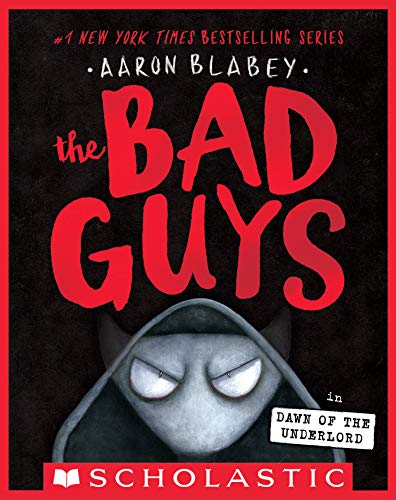


About The Bad Guys
Aaron Blabey’s Bad Guys series is an illustrated children’s adventure-comedy about a group of animals burdened with some of the worst reputations in popular culture who decide to prove that they can be heroes. Beginning with The Bad Guys in 2015, the series follows Mr. Wolf, Mr. Snake, Mr. Shark, and Mr. Piranha as their initially simple attempts to perform good deeds escalate into increasingly wild battles involving mad scientists, monsters, aliens, alternate dimensions, and threats to the entire world.
Mr. Wolf creates the group. He is tired of being regarded as a villain simply because wolves have spent centuries playing that role in stories, so he establishes the Good Guys Club and recruits several animals whose reputations are equally disastrous. Unfortunately, his prospective heroes are not all enthusiastic about reform.
Mr. Snake is cynical and frequently prefers behaving exactly as people expect a snake to behave. Mr. Shark is enormous and intimidating but proves surprisingly versatile, particularly when attempting ridiculous disguises. Mr. Piranha is small, aggressive, and associated with one of the series’ longest-running varieties of bathroom humor. Together they form a team that looks considerably more likely to commit a crime than prevent one.
Their first missions are deliberately modest. Mr. Wolf wants the group to demonstrate its goodness by performing rescues, but even helping a cat out of a tree becomes complicated when the rescuers include animals the cat naturally assumes intend to eat it. The joke establishes one of the series’ central ideas: changing yourself is difficult when everyone else has already decided what you are.
The story quickly grows beyond these early attempts at public relations. Dr. Marmalade, an apparently adorable guinea pig, emerges as a major antagonist whose outward appearance contrasts sharply with his ambitions. Blabey repeatedly reverses assumptions in this way. Traditionally frightening animals attempt heroism, while creatures that appear harmless can become dangerous villains.
As the books progress, the scale changes dramatically. What begins as a comic caper about misunderstood animals evolves into a serialized action story incorporating science fiction, superhero conventions, apocalyptic threats, time and dimensional complications, transformations, and increasingly elaborate mythology. The books remain funny, but later installments depend much more heavily on events established earlier in the sequence.
Additional characters become essential to the group’s adventures. Agent Fox initially appears as an exceptionally capable figure whose history and abilities are more complicated than Mr. Wolf realizes. Other allies and enemies broaden the cast, while revelations about the principal characters challenge the simple labels of “good guy” and “bad guy” that inspired the series in the first place.
Friendship becomes increasingly important beneath the jokes. Mr. Wolf may have assembled the group to improve their reputations, but the Bad Guys gradually become a genuine team. Their personalities clash constantly, particularly when Mr. Snake’s suspicion and pessimism collide with Wolf’s determination to believe in heroic possibilities. Those disagreements give later events emotional weight that would not exist if the characters were merely interchangeable comic figures.
Blabey tells the story through a hybrid format somewhere between an illustrated chapter book, comic book, and graphic novel. Large drawings, speech balloons, exaggerated typography, visual sound effects, short passages of prose, and cinematic action sequences allow pages to move quickly. The format is especially accessible to children transitioning from picture books to longer independent reading.
The artwork also handles much of the characterization. Mr. Snake’s expressions can communicate suspicion without explanation, Shark’s size makes his disguises inherently absurd, and Wolf’s attempts to project heroic confidence can collapse within a single panel. Blabey uses the relationship between text and illustration to control timing in much the same way an animated comedy uses editing.
Unlike Pig the Pug, where individual books can generally stand alone, The Bad Guys becomes increasingly dependent on continuity. Early installments introduce characters and conflicts that matter later, and later volumes frequently end with developments leading directly into the next adventure. Publication order is therefore strongly recommended.
The original main series develops through twenty numbered adventures, culminating in One Last Thing. Rather than continuing indefinitely with the same structure, Blabey gives that sequence a defined endpoint. The popularity of the characters has nevertheless expanded The Bad Guys into a larger franchise, including related books and screen adaptations.
DreamWorks Animation adapted the series into the 2022 film The Bad Guys. The movie uses Blabey’s characters and basic premise while creating its own storyline rather than reproducing the books scene by scene. Its success led to additional animated projects and the theatrical sequel The Bad Guys 2 in 2025.
Across the books, the central joke eventually becomes a serious theme. Wolf, Snake, Shark, and Piranha begin with identities assigned to them by other people’s stories. Their adventures ask whether reputation determines character or whether someone repeatedly described as a villain can choose something different. Blabey surrounds that question with explosions, disguises, absurd villains, and relentless jokes, but the answer remains remarkably consistent: being a good guy is less about looking the part than deciding what kind of friend you are when things go wrong.