
Below is the complete list of Kate Carlisle’s Bibliophile books in order. For this series, the chronological reading order is the same as the order of publication.
Publication Order of Bibliophile Books





About Bibliophile
Kate Carlisle’s Bibliophile Mysteries combine traditional cozy mystery with the specialized world of rare books, bookbinding, restoration, and collecting. Beginning with Homicide in Hardcover in 2009, the series follows Brooklyn Wainwright, a professional bookbinder whose work repeatedly brings her into contact with valuable volumes, unusual manuscripts, obsessive collectors, and murder. The books are largely self-contained mysteries, but Brooklyn’s relationships and personal life develop substantially across the series, making publication order the most satisfying way to follow them.
Brooklyn learned bookbinding in the Northern California commune where she grew up, studying under renowned bookbinder Abraham Karastovsky. Her unusual upbringing remains an important part of her character. Her parents and the wider community provide Carlisle with a colorful supporting cast, while Brooklyn’s combination of technical expertise, curiosity, and persistence makes her particularly well equipped to notice details that others overlook.
In Homicide in Hardcover, Brooklyn attends an event at the Covington Library in San Francisco honoring Abraham and his work. When her mentor is attacked and dies, Brooklyn finds herself drawn into the investigation. The murder establishes a pattern that runs throughout the series: an important book or literary artifact becomes connected to secrets that someone is prepared to protect through violence.
The bibliophile element is considerably more than decoration. Brooklyn understands how books are constructed, repaired, authenticated, and preserved. Carlisle draws on the vocabulary and techniques of bookbinding while exploring the wider culture surrounding rare books. Private libraries, collectors, antiquarian booksellers, museums, manuscripts, first editions, and restoration projects can all become important to a mystery.
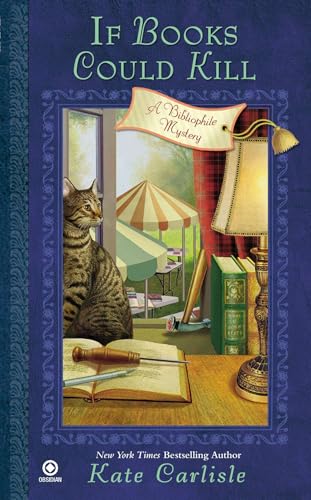
Individual installments often revolve around a particularly intriguing volume. If Books Could Kill takes Brooklyn to Edinburgh and involves a controversial manuscript associated with Robert Burns, while The Lies That Bind brings murder into a bookbinding class. Later books continue to use literary objects as catalysts for crimes involving ownership, inheritance, forgery, hidden information, historical secrets, and the enormous financial or emotional value people can attach to books.
One of the most important continuing characters is Derek Stone, a British security expert whom Brooklyn encounters early in the series. Their relationship develops gradually rather than resetting after each mystery. Derek is capable enough to understand the danger surrounding Brooklyn’s investigations, although that rarely prevents her from becoming involved. Their romance eventually becomes an important part of the series’ continuity.
Brooklyn’s family is equally distinctive. Her parents, Becky and Jim, and the unconventional community associated with her upbringing give the books a warmer and more eccentric dimension outside the murders. Carlisle gradually expands this circle so that recurring friends, relatives, professional contacts, and acquaintances make Brooklyn’s world feel increasingly established.
The series also changes geographically as it develops. San Francisco and Northern California remain important, but Brooklyn’s expertise can take her elsewhere for conferences, commissions, exhibitions, and unusual restoration jobs. This flexibility prevents the mysteries from being confined to a single shop or village while preserving the familiar characters that give the series its cozy identity.
Although the books contain humor and romance, the mysteries themselves frequently involve substantial motives. A rare volume can represent money, prestige, family history, academic reputation, or evidence somebody wants destroyed. Carlisle makes effective use of the contrast between beautiful books and the destructive behavior they inspire. Objects created to preserve knowledge become reasons for people to lie, steal, and kill.
Brooklyn also grows into her investigative role. In the earliest books, her involvement is largely circumstantial, beginning with the murder of someone personally important to her. Repeated encounters with crime make her increasingly confident about questioning suspects and interpreting behavior, but she remains a bookbinder rather than becoming a professional detective. Her specialized knowledge often supplies the clue that conventional investigators might not immediately recognize.
Publication order matters more as the series progresses because marriages, friendships, family developments, and other personal changes carry forward. The murder plots can usually be understood independently, but reading randomly can reveal later developments before their natural progression.
The Bibliophile Mysteries ultimately succeed by making Brooklyn’s profession inseparable from the crimes she solves. Carlisle treats books as physical objects with histories—objects that can be altered, forged, hidden, damaged, inherited, stolen, and restored. Brooklyn understands that a binding can conceal something unexpected and that the condition of a book can reveal what happened to it. The same principle repeatedly applies to the people around her: appearances can be carefully constructed, but close examination eventually exposes what lies underneath.