
Below is the complete list of Jamie Freveletti books in order. For each series, the chronological reading order is the same as the order of publication.
Publication Order of Emma Caldridge Books



Publication Order of Covert-One Books


About Jamie Freveletti
Jamie Freveletti is an American thriller writer and former trial attorney whose fiction combines scientific danger, international pursuit, political conspiracy, and protagonists forced to rely on specialized knowledge under extreme pressure. She is best known for creating biochemist and endurance athlete Emma Caldridge and for contributing two novels to Robert Ludlum’s Covert-One series. Her legal career, international studies, distance running, and martial-arts training give her work an unusual blend of analytical precision and physically demanding action.
Freveletti grew up in Addison, Illinois, and graduated from Chicago-Kent College of Law in 1985. She subsequently lived in Geneva, Switzerland, where she earned a diploma in international studies. After returning to Chicago, she practiced as a trial attorney, handling matters that included class-action litigation, mass-tort claims, and securities fraud. That experience gave her direct familiarity with evidence, expert testimony, institutional responsibility, and disputes in which scientific or technical information must be translated into persuasive human terms.
Outside the courtroom, Freveletti became an endurance runner and earned a black belt in aikido. Those interests strongly influenced Emma Caldridge, who is neither a conventional detective nor a government-trained operative. Emma is a chemist whose intelligence, scientific training, physical stamina, and ability to remain composed in hostile environments repeatedly place her at the center of international crises.
Freveletti’s debut, Running from the Devil, begins after a plane is destroyed over the Colombian jungle. Emma survives the crash and follows the guerrillas who have taken other passengers hostage, drawing on her knowledge of chemistry and long-distance running rather than formal combat experience. Published in 2009, the novel won the International Thriller Writers Award for Best First Novel and a Barry Award, while also receiving recognition from independent booksellers and mystery organizations.
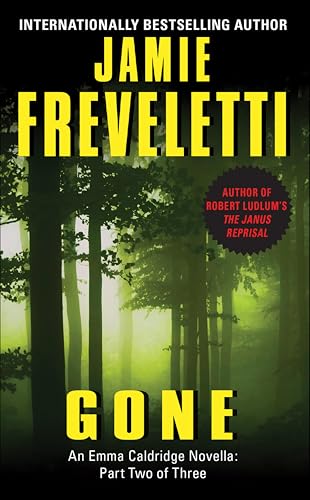
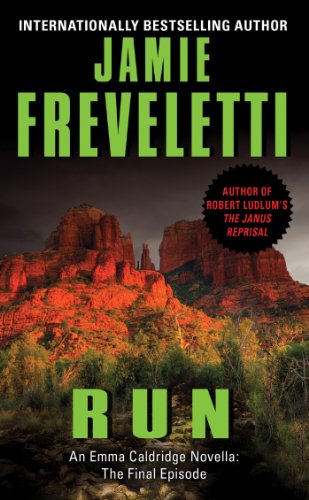
The Emma Caldridge sequence continued through novels including Running Dark, The Ninth Day, Dead Asleep, and Blood Run. The stories move through Africa, Mexico, the Caribbean, and other dangerous settings while confronting piracy, human trafficking, biological weapons, pharmaceutical interests, infectious disease, and covert security operations. Edward Banner and the private security company Darkview provide an important connection across the series, but Emma remains independent of the organizations attempting to recruit, manipulate, or protect her. The shorter works Risk, Gone, and Run form a linked novella originally released in parts and should not be mistaken for three unrelated full-length novels.
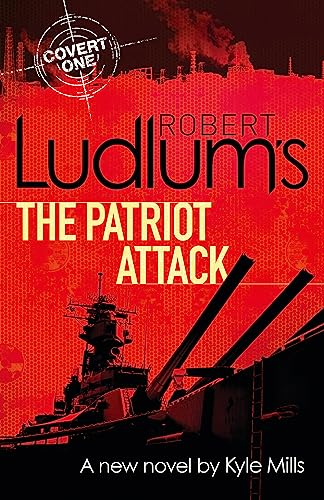
Freveletti entered Robert Ludlum’s continuing Covert-One franchise with The Janus Reprisal. She followed it with The Geneva Strategy, bringing her scientific-thriller strengths to a series built around Lieutenant Colonel Jon Smith and a secret American agency responding to threats involving biotechnology, advanced weapons, and compromised government institutions. These books belong within the wider Covert-One chronology rather than the Emma Caldridge continuity.
Her shorter fiction has appeared in collections inspired by Sherlock Holmes and in other anthologies, while her nonfiction contribution to Anatomy of Innocence reflects her legal background through accounts connected to wrongful conviction. She has also moved toward supernatural suspense in work such as Infinity, which explores disappearances and ghostly disturbances at a New England inn.
Freveletti’s bibliography is best understood by separating the Emma Caldridge adventures, the Covert-One continuation novels, and her anthology or independent work. Across those categories, she writes capable protagonists whose greatest advantage is not force but informed judgment—the ability to recognize what a substance, disease, document, or fragment of evidence reveals before more powerful institutions understand the danger.