
Below is the complete list of Francine Rivers’ Lineage of Grace books in order. For this series, the chronological reading order is the same as the order of publication.
Publication Order of Lineage of Grace Books



About Lineage of Grace
Francine Rivers’s Lineage of Grace series is a five-novella collection of biblical historical fiction centered on Tamar, Rahab, Ruth, Bathsheba, and Mary—the five women specifically named in the genealogy of Jesus in the Gospel of Matthew. Rather than retelling the Bible broadly, Rivers concentrates on each woman individually, expanding the relatively concise scriptural accounts into character-driven stories about faith, courage, scandal, loss, obedience, and the unexpected ways apparently marginal lives become important within a much larger history.
Unveiled begins with Tamar, whose story comes from Genesis. Widowed twice and denied the future promised to her through Judah’s family, Tamar takes extraordinary action to secure the rights and lineage that have been withheld from her. Rivers presents her as a woman navigating a patriarchal culture in which marriage, inheritance, and motherhood largely determine security. Her controversial decision becomes part of a larger story about justice, persistence, and a family line continuing through circumstances few would have predicted.
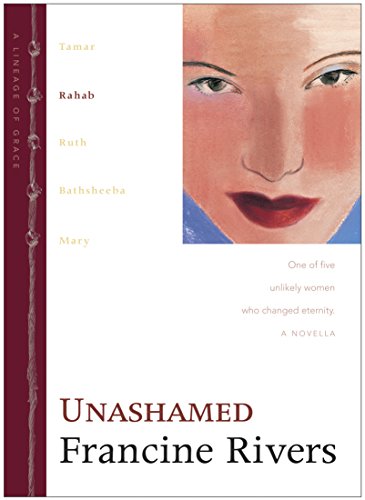
Unashamed turns to Rahab in Jericho as the Israelites prepare to enter Canaan. Known in Scripture as a prostitute, Rahab shelters Israelite spies and chooses to align herself with their God even though doing so places her in direct conflict with her own city. Her story is therefore as much about changing allegiance as physical survival. Rivers emphasizes the distance between Rahab’s past and the future she ultimately receives within Israel.
Unshaken follows Ruth, the Moabite widow who refuses to abandon her mother-in-law Naomi after both women suffer devastating family losses. Ruth’s decision to leave her homeland and accompany Naomi to Bethlehem eventually brings her into the orbit of Boaz. The familiar love story remains important, but Rivers places equal emphasis on loyalty, poverty, cultural displacement, and Ruth’s willingness to build a new life among people who initially regard her as a foreigner.
Bathsheba’s story is explored in Unspoken. Her relationship with King David has traditionally been associated with adultery, the death of her husband Uriah, and one of the darkest episodes of David’s reign. Rivers expands the story beyond that moment, following Bathsheba through grief, motherhood, palace life, and the consequences of David’s choices. Her later position as the mother of Solomon gives the novella a wider perspective on restoration and the complicated legacy of a relationship that began in scandal and tragedy.
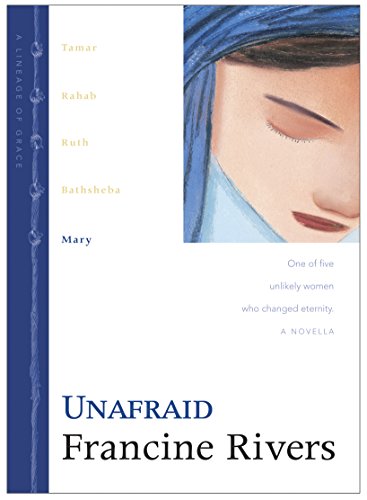
Unafraid completes the sequence with Mary, the young Jewish woman who accepts the extraordinary announcement that she will give birth to Jesus. Rivers follows her beyond the Nativity, considering the social danger surrounding her pregnancy, her marriage to Joseph, family life, and the experience of watching her son’s ministry eventually lead to rejection and crucifixion.
The five women are separated by centuries and profoundly different circumstances, so Lineage of Grace does not operate as a continuous narrative in the conventional sense. Its continuity comes through genealogy and theme. Tamar, Rahab, Ruth, Bathsheba, and Mary all occupy crucial places within the ancestry leading to Christ, yet each enters that lineage through circumstances involving vulnerability, outsider status, scandal, or personal risk.
Rivers also appended Bible-study material to the individual novellas, reinforcing that the series was designed not simply as historical entertainment but as an imaginative companion to the biblical texts. The five stories were later collected into the omnibus A Lineage of Grace. Read together, they form a focused exploration of women whose lives are often compressed into relatively brief passages of Scripture but whose choices become central to one of the Bible’s most important genealogical narratives.