
Below is the complete list of Beverly Cleary’s Henry Huggins books in order. For this series, the chronological reading order is the same as the order of publication.
Publication Order of Henry Huggins Books




About Henry Huggins
Beverly Cleary’s Henry Huggins series is a six-book children’s sequence about an ordinary boy growing up on Klickitat Street in Portland, Oregon, alongside his dog Ribsy and a neighborhood cast that includes Beezus Quimby, Ramona Quimby, and Scooter McCarthy. Beginning with Henry Huggins in 1950 and ending with Ribsy in 1964, the series was Cleary’s first major fictional world and became the foundation from which her better-known Ramona books eventually developed.
Henry is not a child chosen for extraordinary adventures. His problems are bicycles, dogs, paper routes, clubhouses, friendships, money-making schemes, and the embarrassing complications that arise when perfectly reasonable plans encounter other children, adults, or Ribsy. That everyday scale is essential to Cleary’s achievement. She had wanted to write the kind of funny neighborhood stories she could not find easily as a young reader and later heard children requesting while she worked as a librarian. Henry became one of the clearest expressions of that idea.
Henry Huggins establishes the relationship that anchors the series when Henry encounters the scruffy dog he names Ribsy. Their adventures are episodic, allowing Cleary to turn commonplace childhood situations into comic crises while gradually building a recognizable neighborhood around them. Henry is practical and eager to prove himself capable, but his enthusiasm regularly gets ahead of experience.
The supporting characters become increasingly important as the books continue. Henry and Beezus gives Beatrice “Beezus” Quimby a substantial role as Henry tries to earn enough money for the red bicycle he desperately wants. Her younger sister Ramona, still a relatively minor character at this stage, creates exactly the sort of disruption that will eventually make her the center of Cleary’s most famous series. Cleary later explained that Ramona was initially introduced almost accidentally because she realized the children in Henry Huggins all seemed to be only children.
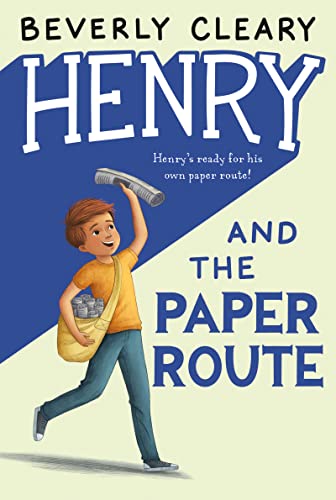
Henry’s ambitions change as he gets older. In Henry and the Paper Route, he becomes determined to secure a newspaper route despite being younger than the expected age, while Henry and the Clubhouse shows him dealing with the responsibilities that come after achieving that goal. These small milestones give the series a subtle progression: Henry wants greater independence, earns it in stages, and repeatedly discovers that responsibility is more complicated than it appeared from the outside.
Ribsy remains the unpredictable force running through nearly everything Henry attempts. The final book, Ribsy, shifts the viewpoint significantly by concentrating on the dog after he becomes separated from the Huggins family. Henry remains part of the story, but Ribsy effectively becomes the protagonist, giving the series an appropriate conclusion for a character who had been inseparable from Henry since the beginning.
The Henry books also overlap naturally with Cleary’s wider Klickitat Street world. Beezus and Ramona move from supporting roles into stories of their own, while familiar neighbors recur across different books. That interconnectedness makes Henry Huggins important beyond its six principal volumes: it is where Cleary first created the Portland neighborhood that would support some of the most enduring characters in American children’s fiction.
What gives the series its longevity is Cleary’s respect for ordinary childhood. Henry wants adults to take him seriously, wants possessions he cannot immediately afford, wants freedom without always understanding responsibility, and sometimes finds girls or younger children inconvenient simply because they interfere with his plans. Cleary turns those modest concerns into stories with genuine stakes because, from Henry’s perspective, they are genuine stakes. The result is a series in which growing up happens almost unnoticed, one bicycle, paper route, friendship, and runaway dog at a time.