
Below is the complete list of Christopher Moore’s Grim Reaper books in order. For this series, the chronological reading order is the same as the order of publication.
Publication Order of Grim Reaper Books

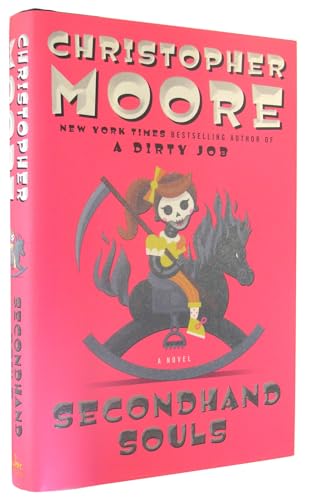
About Grim Reaper
Death becomes an unexpectedly complicated occupation in Christopher Moore’s Grim Reaper series, a darkly comic exploration of mortality, supernatural responsibility, and the absurdities of everyday life. Set in San Francisco, the novels follow an ordinary secondhand shop owner who discovers that he has been recruited to help manage the passage of human souls. Beginning with A Dirty Job in 2006 and continuing with Secondhand Souls in 2015, the series combines urban fantasy, supernatural suspense, and Moore’s distinctive irreverent humor.
Charlie Asher is hardly an obvious candidate for a supernatural calling. A nervous, self-conscious businessman who worries excessively about almost everything, he owns a secondhand store and enjoys a relatively comfortable life with his wife, Rachel. His circumstances change dramatically when Rachel dies shortly after giving birth to their daughter, Sophie. During this devastating experience, Charlie encounters a mysterious figure who introduces him to a hidden system governing what happens to human souls after death.
Charlie gradually learns that he has become a Death Merchant, one of several individuals responsible for collecting objects containing the souls of deceased people. These objects must eventually reach new owners, allowing the souls to continue their journeys. The arrangement operates according to peculiar supernatural rules that Charlie struggles to understand, particularly because nobody has provided him with adequate instructions for his extraordinary responsibilities.
His secondhand business becomes unexpectedly useful in this occupation. Ordinary possessions acquire supernatural significance, and the distinction between valuable merchandise and spiritually important objects becomes increasingly difficult to maintain. Moore uses this premise to transform familiar activities such as buying, selling, and organizing household items into situations involving mysterious forces and potentially catastrophic consequences.
Charlie’s personal circumstances remain central to the narrative. As a widowed father raising Sophie, he must balance parental responsibilities with an occupation that exposes him to supernatural dangers. His anxiety and reluctance to accept extraordinary events contrast with the increasingly bizarre situations surrounding him, creating much of the series’ humor.
The supporting characters contribute significantly to its unusual atmosphere. Minty Fresh, another Death Merchant, provides Charlie with insight into his new responsibilities, while the formidable creatures known as the Morrigan introduce a darker dimension to the supernatural world. Sophie’s unusual abilities and the presence of two enormous hellhounds further complicate Charlie’s attempts to maintain anything resembling a normal household.
Secondhand Souls expands the mythology established in the opening novel. Human souls begin disappearing in San Francisco, threatening the delicate system responsible for their passage. Charlie and his unconventional allies must confront a new supernatural crisis while dealing with the consequences of earlier events. The sequel places greater emphasis on the interconnected characters and the increasingly complicated relationship between the living, the dead, and those responsible for maintaining the balance.
San Francisco provides an important link between the Grim Reaper novels and Moore’s wider fictional universe. Characters including the Emperor of San Francisco and police detectives Rivera and Cavuto also appear in his vampire fiction, particularly the Bloodsucking Fiends trilogy. These recurring figures create a shared supernatural environment in which different stories occasionally overlap without losing their individual identities.
Moore’s treatment of death is deliberately unconventional. Rather than presenting mortality exclusively through tragedy or horror, he explores its practical, emotional, and philosophical dimensions through comedy. Grief, parental love, loneliness, and the uncertainty of existence remain meaningful concerns even as the characters confront absurd supernatural circumstances.
The contrast between Charlie’s ordinary personality and his extraordinary responsibilities gives the novels their emotional foundation. His determination to protect his daughter and maintain his humanity frequently matters more than his understanding of supernatural rules. The humor emerges not simply from bizarre events but from the recognizable anxieties of a man attempting to fulfill responsibilities for which he feels entirely unqualified.
Christopher Moore also identifies these interconnected books as the Death Merchant Chronicles, a name reflecting Charlie’s unusual occupation more precisely than the commonly used Grim Reaper designation. Both titles refer to the same central storyline.
Through Charlie Asher and his eccentric companions, the series examines the strange relationship between life and death without abandoning the warmth beneath its dark comedy. Its supernatural mythology provides the framework, but the characters’ struggles with loss, responsibility, friendship, and family give the novels their lasting appeal.