
Below is the complete list of Christopher Moore books in order. For each series, the chronological reading order is the same as the order of publication.
Publication Order of Pine Cove Books


Publication Order of Bloodsucking Fiends/Love Story Books


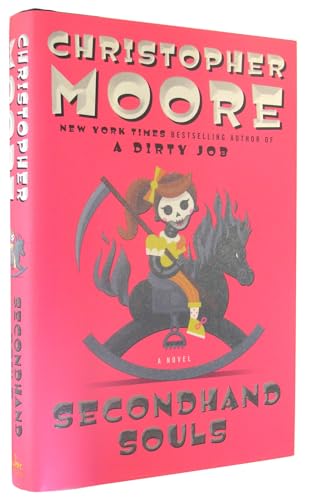
Publication Order of Grim Reaper Books

Publication Order of Fool Books


Publication Order of Sammy and the Cheese Books


Publication Order of Standalone Books


Publication Order of Short Stories/Novellas Books
- Our Lady of the Fishnet Stockings (1987)
Our Lady of the Fishnet Stockings was published in 1987 and is listed as book #1 in the Short Stories/Novellas series. - Cat’s Karma (1987)
Published in 1987, Cat’s Karma is listed as book #2 in the Short Stories/Novellas series.
Publication Order of Graphic Novels Books

About Christopher Moore
Christopher Moore is an American novelist known for his unconventional blend of comic fantasy, supernatural fiction, satire, and absurdist humor. His novels frequently place ordinary people in extraordinary situations involving demons, vampires, gods, historical figures, and other unlikely companions. Since publishing his debut novel, Practical Demonkeeping, in 1992, Moore has developed a distinctive literary identity built around irreverent dialogue, eccentric characters, inventive storytelling, and a willingness to challenge familiar conventions of religion, mythology, and popular culture.
Moore was born in Toledo, Ohio, and grew up in Mansfield, where his father worked as a highway patrolman and his mother sold household appliances. He attended Ohio State University and later studied at the Brooks Institute of Photography in Santa Barbara, California. Moving to California at nineteen, he spent many years along the state’s Central Coast before relocating to Hawaii in 2003.
Before establishing himself as a novelist, Moore worked in several occupations, including roofing, grocery retail, hotel administration, insurance, waiting tables, photography, and radio broadcasting. These experiences contributed to his understanding of different personalities and workplaces, providing material for the unconventional characters and everyday environments that frequently appear in his fiction.
His debut, Practical Demonkeeping, introduced the fictional California town of Pine Cove, where supernatural disturbances disrupt an otherwise ordinary coastal community. The novel established several characteristics that would become central to his writing, particularly the contrast between mundane human concerns and extraordinary supernatural events. Pine Cove subsequently appeared in other works, including The Lust Lizard of Melancholy Cove and The Stupidest Angel.
Moore reached a wider audience with Lamb: The Gospel According to Biff, Christ’s Childhood Pal, published in 2002. The novel imagines the unrecorded years of Jesus through the perspective of his fictional childhood friend, Biff. Combining historical settings, religious traditions, philosophical questions, and outrageous comedy, it became one of Moore’s best-known works and demonstrated his ability to approach sensitive cultural subjects through imaginative satire.
His fiction also includes several interconnected supernatural narratives. The San Francisco vampire novels, beginning with Bloodsucking Fiends, follow characters navigating romantic complications and the practical difficulties of vampirism. A Dirty Job introduces Charlie Asher, an ordinary man unexpectedly drawn into the business of collecting souls, while its sequel, Secondhand Souls, continues the supernatural complications surrounding death and the afterlife.
Another important part of Moore’s bibliography involves literary reinterpretation. Fool reimagines Shakespeare’s King Lear through the perspective of the court jester Pocket, combining Elizabethan drama with bawdy humor and political intrigue. The character returns in The Serpent of Venice and Shakespeare for Squirrels, extending Moore’s interest in transforming classical literature into unconventional comic adventures.
Historical settings have also become increasingly prominent in his work. Sacré Bleu incorporates nineteenth-century French art and the world of Impressionist painters into a supernatural mystery. Noir and Razzmatazz draw inspiration from hardboiled detective fiction and postwar San Francisco, while Anima Rising, published in 2025, explores early twentieth-century Vienna through a mixture of historical figures, psychological ideas, and speculative storytelling.
Although many of his novels are connected through recurring characters and shared locations, Moore also writes standalone stories that explore entirely different subjects. His bibliography is therefore better understood as a combination of interconnected fictional worlds, literary reinventions, and independent comic fantasies rather than a single continuous narrative.
Moore’s writing stands out for its rapid dialogue, playful language, dark comedy, and frequent contrasts between human vulnerability and supernatural absurdity. Beneath the humor, his stories regularly examine friendship, mortality, faith, loneliness, and the search for meaning. His ability to move between contemporary fantasy, historical fiction, literary parody, and supernatural comedy has made him one of the more recognizable voices in modern American humorous fiction.