
Below is the complete list of Anthony Horowitz’s Daniel Hawthorne books in order. For this series, the chronological reading order is the same as the order of publication.
Publication Order of Daniel Hawthorne Books




About Daniel Hawthorne
Anthony Horowitz’s Daniel Hawthorne series is one of his most playful and formally unusual contributions to modern crime fiction. Usually published under the Hawthorne and Horowitz label, the books feature ex-Detective Inspector Daniel Hawthorne investigating murders while a fictionalized Anthony Horowitz shadows him, records the case, argues with him, and turns the result into the very book the reader is holding. The series began with The Word is Murder and has continued through later entries including Close to Death and A Deadly Episode, the sixth Hawthorne novel.
The central device is deceptively simple. Hawthorne, a former Metropolitan Police detective with a gift for solving complex cases and a talent for irritating almost everyone around him, approaches Horowitz with a commercial proposition: write about one of his investigations and split the proceeds. Horowitz turns himself into Watson, but a reluctant, self-conscious, often embarrassed Watson who is also a working novelist, screenwriter, and public figure. That metafictional arrangement lets the books operate as traditional whodunits and as sly commentaries on how detective stories are constructed.
Hawthorne is the engine of the mysteries, but he is deliberately opaque. He notices what others miss, asks blunt questions, and keeps emotional distance from nearly everyone, including the narrator who is supposed to understand him. His past emerges only in fragments, and Horowitz repeatedly finds himself both fascinated and unsettled by the man whose cases he has agreed to chronicle. That tension keeps the partnership from becoming cosy. Hawthorne needs Horowitz’s storytelling; Horowitz needs Hawthorne’s cases; neither quite trusts the other.
The early books establish the rhythm of the series through contemporary murders shaped by classic puzzle construction. A strange death, a limited group of suspects, misdirection, withheld motives, and a final explanation all point back to Golden Age crime traditions. Yet Horowitz modernizes the form by placing himself inside it. He worries about contracts, deadlines, publicity, research, plausibility, and the ethics of turning real people’s deaths into entertainment. This running concern gives the series a second mystery beneath each case: not only who committed the murder, but what kind of story Horowitz is allowed to make from it.
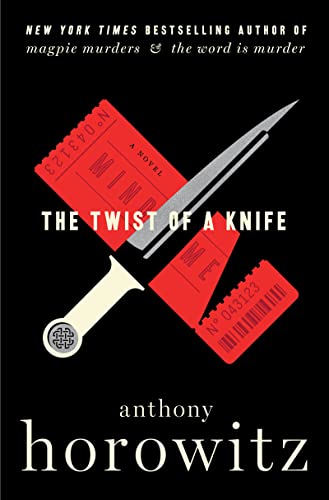
The setting changes also matter. A Line to Kill moves much of the action to a literary festival on Alderney, tightening the suspect pool while satirizing publishing culture. The Twist of a Knife places the fictional Horowitz himself under suspicion after a theatre critic is murdered, forcing the narrator out of observer status and into personal danger. Close to Death adjusts the structure again by giving Hawthorne an earlier case for Horowitz to reconstruct, complicating the usual dynamic between investigation and narration.
The later A Deadly Episode brings the self-referential premise to a new level by involving a film adaptation of The Word is Murder. Hawthorne and Horowitz visit the set, where the actor playing Hawthorne is stabbed, raising the possibility that the killer may have targeted the real detective instead. The official description calls it Hawthorne’s most personal case so far, which fits the series’ gradual movement from murder puzzles toward questions about Hawthorne himself.
Publication order gives the strongest experience because the recurring partnership accumulates unease, humor, irritation, and small revelations. The cases are constructed to satisfy as individual mysteries, but the larger pleasure lies in watching Horowitz turn detective fiction inside out while still honoring its rules. Daniel Hawthorne remains brilliant, abrasive, secretive, and morally difficult to read; the fictional Horowitz remains the narrator trying, and often failing, to catch up.