
Below is the complete list of Susan Meissner’s Rachael Flynn books in order. For this series, the chronological reading order is the same as the order of publication.
Publication Order of Rachael Flynn Books


About Rachael Flynn
Susan Meissner’s Rachael Flynn series is a three-book mystery sequence following a Minnesota-born attorney whose instinct for questioning convenient explanations repeatedly draws her into cases outside the ordinary boundaries of her legal work. Written before Meissner became primarily associated with historical fiction, the trilogy combines crime and suspense with marriage, motherhood, faith, ethical dilemmas, and an unusually creative supporting cast. Rachael’s investigations are important, but the books are equally interested in the effect those cases have on the people closest to her.
Widows & Orphans introduces Rachael at a particularly personal moment. Her younger brother, Joshua, has been arrested for murder and has confessed, despite everything Rachael knows about his character. Joshua has devoted himself to helping disadvantaged people, making the idea that he deliberately killed someone difficult for her to accept. More troublingly, he refuses her offer to represent him and shows little interest in defending himself.
Rachael becomes convinced that Joshua is protecting someone. Her search for an alternative explanation brings her husband, Trace, into the investigation along with several of his artist friends. Their involvement gives the series one of its more distinctive features: instead of relying solely on conventional police methods, Meissner sometimes uses the artists’ ability to visualize scenes and interpret details differently as another way of approaching a mystery. Rachael’s marriage to Trace and their life with infant daughter McKenna also prevent her from becoming an isolated amateur sleuth whose personal world disappears whenever a case begins.
Sticks & Stones broadens the series beyond Rachael’s family. An anonymous letter tells her that a body will be discovered at the Prairie Bluff construction site and claims that the death was accidental. When remains are indeed uncovered, investigators learn that the victim was fifteen-year-old Randall Buckett and that he had been buried there roughly twenty-five years earlier.
The mystery immediately raises questions about why someone has chosen Rachael as the recipient of information about a decades-old death. Detective Will Pendleton becomes an important part of the investigation as Rachael tries to determine whether the anonymous writer witnessed the crime, caused it, or has another reason for reopening the past. The case gives Meissner room to explore memory, guilt, responsibility, and the difficulty of discovering reliable truth after people have spent decades living with secrets.
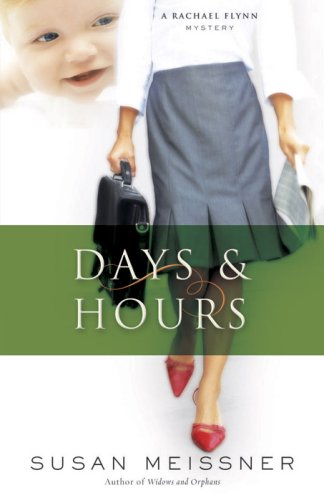
Days & Hours turns to a more immediate and emotionally charged case. A newborn baby is discovered alive in a trash container, while the child’s young mother insists that someone abducted him. Police have reason to doubt her account, but Rachael becomes increasingly convinced that the woman may be telling the truth. When the baby disappears again, what appeared to be a case of neglect or attempted abandonment becomes considerably more complicated.
Across the trilogy, Rachael is not presented as a traditional police detective. Her legal training gives her an analytical approach, but empathy and intuition frequently push her to investigate situations others have already categorized. That tendency can create risk, particularly because she has a husband and young child whose lives continue alongside her investigations.
The books also reflect the inspirational-fiction roots of this period in Meissner’s career. Questions of conscience, sacrifice, compassion, forgiveness, and faith emerge naturally from the crimes rather than existing separately from them. Characters must often decide not merely what is legal or provable, but what they owe to people who are frightened, vulnerable, or guilty of complicated choices.
Rachael Flynn is therefore a notably different corner of Meissner’s bibliography from the historical novels for which she later became best known. The trilogy is contemporary, compact, and mystery-driven, but it already shows her enduring interest in hidden histories and morally difficult decisions. Its continuity comes from Rachael, Trace, their family life, and recurring relationships, while each investigation gives those characters a new problem in which the obvious explanation is rarely the whole truth.