
Below is the complete list of Octavia E. Butler’s Patternmaster books in order. For this series, the chronological reading order is the same as the order of publication.
Publication Order of Patternmaster Books




About Patternmaster
Octavia E. Butler’s Patternmaster series, also known as the Patternist series, is a science fiction saga exploring telepathy, genetic manipulation, immortality, disease, and the struggle for power. Published between 1976 and 1984, its five original novels span thousands of years, tracing the development of a society in which individuals with extraordinary mental abilities dominate those without them. The series is especially notable for its unusual publication chronology and Butler’s examination of coercion, hierarchy, and the biological foundations of power.
The sequence began with Patternmaster in 1976, Butler’s first published novel. Set in a distant future, it depicts a society controlled by telepathic humans known as Patternists. These individuals are connected through a powerful psychic network called the Pattern, which allows communication, influence, and control. Their society is organized around a rigid hierarchy, with the strongest telepaths holding authority over weaker members.
At the center of Patternmaster is Teray, a young telepath whose struggle for independence brings him into conflict with established power structures. His experiences reveal the dangers of a society in which mental ability determines social status and personal freedom depends upon the strength of one’s psychic gifts.
Butler then moved backward in the fictional timeline with Mind of My Mind (1977). The novel follows Mary, a young telepath whose abilities allow her to establish the Pattern itself. Her emergence threatens Doro, an ancient being who has spent centuries manipulating human reproduction to produce individuals with increasingly powerful psychic abilities.
Doro becomes central to the series’ deeper history. He is effectively immortal, surviving by transferring his consciousness into new bodies, a process that kills the previous occupant. His extraordinary longevity allows him to conduct a breeding program across generations, treating human lives as instruments of his ambitions.
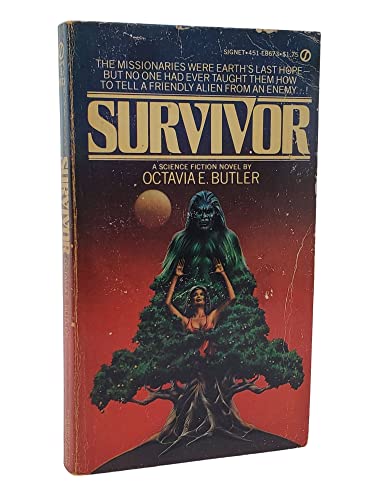
Survivor (1978), the third published novel, takes place within the broader Patternist universe but follows a different storyline. It concerns Alanna, a young woman associated with a group of human survivors who leave Earth and encounter intelligent alien species on another planet. Although connected to the series’ future history, its emphasis on human-alien relations makes it distinct from the novels centered on Doro and the Pattern.
Butler later expressed dissatisfaction with Survivor and chose not to keep it in print. Consequently, modern editions of the Patternist series generally exclude the novel, and it is often described as a four-book sequence despite having originally contained five published installments.
Wild Seed (1980) moves the story much further into the past, beginning in seventeenth-century Africa. It introduces Anyanwu, a woman with extraordinary healing and shapeshifting abilities, and explores her complicated relationship with Doro.
Anyanwu possesses powers that make her exceptionally valuable to Doro’s breeding program, but she resists his attempts to control her. Their relationship develops across generations, combining dependence, conflict, affection, and coercion. Through these characters, Butler examines the difference between possessing power and using it responsibly.
The final published installment, Clay’s Ark (1984), takes place in a future affected by an extraterrestrial microorganism brought to Earth by a returning spacecraft. The infection alters human biology and behavior, creating a new population whose existence threatens conventional human society.
Although Clay’s Ark differs considerably from the earlier novels in atmosphere and narrative structure, it helps explain the emergence of the Clayarks, a group that plays an important role in the distant future depicted in Patternmaster. Its combination of biological horror and social conflict reflects Butler’s recurring interest in adaptation under extreme circumstances.
The Patternmaster books can be approached in either publication order or internal chronological order. Publication order begins with Patternmaster, followed by Mind of My Mind, Survivor, Wild Seed, and Clay’s Ark. This arrangement reveals the fictional universe in the sequence Butler developed it, although Survivor is difficult to obtain because of its withdrawn status.
For readers using the four novels currently available in standard editions, chronological order begins with Wild Seed, continues through Mind of My Mind and Clay’s Ark, and concludes with Patternmaster. This sequence follows the development of Doro’s breeding program, the creation of the Pattern, and the eventual emergence of the future Patternist society.
The series is unusual because its central conflict evolves across enormous spans of time. Characters who dominate one historical period may become distant influences on another, while decisions made centuries earlier shape societies that later generations take for granted.
Butler also refuses to portray extraordinary abilities as inherently liberating. Telepathy can create intimacy and cooperation, but it can also enable surveillance, domination, and the destruction of individual autonomy. Similarly, biological adaptation may ensure survival while fundamentally changing what it means to be human.
The Patternmaster series established many of the themes Butler would continue exploring in Kindred, Xenogenesis, and Earthseed. Its combination of speculative biology, historical perspective, and morally complicated power relationships makes it an essential part of her development as a science fiction writer.