
Below is the complete list of Wilbur Smith’s Ballantyne books in order. For this series, the chronological reading order is the same as the order of publication.
Publication Order of Ballantyne Books


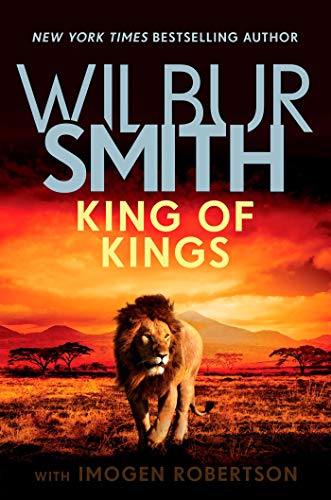

- Fire on the Horizon (2024)
(With Imogen Robertson)
Fire on the Horizon is a 2024 release and appears as book #8 in the Ballantyne series.
About Ballantyne
Wilbur Smith’s Ballantyne series is a multigenerational historical saga set largely in southern Africa, particularly the region that became Zimbabwe. Beginning with A Falcon Flies, the novels follow the Ballantyne family through exploration, missionary work, trade, political conflict, warfare, and the expansion of European power into the African interior. Like Smith’s better-known Courtney novels, the series combines family drama with large historical events, but the Ballantyne books place particular emphasis on nineteenth-century colonial expansion and the turbulent development of Rhodesia.
The series begins with Robyn and Zouga Ballantyne, siblings returning to Africa after years abroad. Their father, Fuller Ballantyne, had been a missionary and explorer, and both children are shaped by his legacy in different ways. Robyn is driven by a strong moral and religious purpose, while Zouga is more ambitious, adventurous, and willing to pursue wealth and influence.
A Falcon Flies follows their journey into the African interior and establishes the central tensions that will continue through later generations. Smith places the Ballantynes amid the realities of the ivory trade, slavery, tribal politics, missionary activity, and competing European interests. The book introduces a family whose members can share blood without sharing values, creating internal conflicts that become as significant as the dangers surrounding them.
Zouga becomes one of the defining figures of the saga. His ambition leads him through military service, exploration, mining, and political involvement, while his descendants inherit both his determination and the consequences of his choices. Robyn’s branch provides a contrasting perspective, often emphasizing humanitarian and moral questions that complicate the family’s relationship with imperial expansion.
The second major novel, Men of Men, moves deeper into the period of Cecil Rhodes and the British South Africa Company. Zouga becomes involved in the search for mineral wealth and in the expansion northward, while the next generation begins assuming greater prominence. The novel captures the feverish mixture of idealism, greed, adventure, and violence that accompanied the occupation of territories later known as Rhodesia.
The Angels Weep continues the saga across two major periods. The first part deals with the Matabele uprisings of the 1890s, while the later portion moves forward into the twentieth century. Smith uses this structure to show how conflicts thought to belong to one generation continue affecting descendants decades later. The Ballantynes are no longer simply outsiders entering a frontier; they have become part of the social and political order whose future is being contested.
The original sequence culminates with The Leopard Hunts in Darkness. Set against the political tensions of post-independence Zimbabwe, it brings the family story into a very different historical landscape. The colonial world that shaped earlier generations has ended, but questions of power, loyalty, corruption, land, and national identity remain. The novel connects personal danger with the political instability of a newly independent state.
Across the series, Smith repeatedly explores the relationship between individuals and historical forces larger than themselves. The Ballantynes may influence events through wealth, military service, political connections, or personal courage, but they cannot escape the consequences of the systems in which they participate. Ambition brings opportunity, yet it can also create lasting resentment and violence.
The novels are also notable for their wide range of perspectives. European settlers, missionaries, soldiers, traders, African leaders, and members of different generations all contribute to the changing picture of southern Africa. Smith’s treatment reflects the adventure-fiction tradition in which he worked, and some portrayals of colonial history, race, and power are shaped by the assumptions and conventions of their era. At the same time, the books repeatedly show that conquest and political expansion carry severe human costs.
The Ballantyne series later became more closely connected with Smith’s Courtney saga. In later works, the histories of the two families intersect, and some bibliographies group newer novels under a combined Courtney and Ballantyne designation. This reflects Smith’s gradual transformation of separate family sagas into a broader fictional history of Africa.
Publication order remains the most natural way to approach the Ballantyne novels because the family relationships and historical consequences develop progressively. The sequence moves forward through generations, allowing the reader to see how ambitions established in the nineteenth century echo into the political struggles of the twentieth.
The Ballantyne saga is ultimately a story about inheritance in its broadest sense. Each generation receives not only wealth, property, and family reputation, but also unresolved rivalries, political loyalties, and moral consequences. Smith uses the family to trace a changing southern Africa from exploration and imperial expansion through rebellion and independence, making the Ballantynes both participants in history and prisoners of the legacy created by those who came before them.