
Below is the complete list of Mick Herron’s Zoe Boehm books in order. For this series, the chronological reading order is the same as the order of publication.
Publication Order of Zoe Boehm Books



About Zoe Boehm
Mick Herron’s Zoë Boehm series is a four-book crime sequence built around private investigation, damaged loyalties, buried conspiracies, and the uneasy partnership between Oxford investigator Zoë Boehm and Sarah Tucker. Written before Herron became internationally known for the Slough House novels, the books already display many of his defining strengths: dry humor, sudden violence, institutional mistrust, morally compromised characters, and plots that refuse to unfold in predictable straight lines. The series begins with Down Cemetery Road, Herron’s 2003 debut novel, and develops through three further thrillers.
The opening book is unusual because Sarah Tucker, rather than Zoë alone, provides much of the narrative drive. Sarah is living an unsatisfying suburban life in Oxford when a nearby house explodes and a young girl disappears in the aftermath. Dissatisfied with the official response, she becomes obsessed with discovering what happened. Her search brings her into contact with private investigators Zoë Boehm and Joe Silvermann and gradually exposes a conspiracy extending far beyond one damaged house. What begins as a missing-child mystery grows into a story involving hidden identities, apparent deaths, government-linked forces, and people prepared to kill to keep the past buried.
That structure establishes an important feature of the series: Zoë is its recurring investigative figure, but Herron does not treat every novel as a conventional detective case with an unchanging protagonist solving a neatly contained mystery. Sarah remains significant, personal consequences carry forward, and the books repeatedly allow earlier violence to alter later behavior. Zoë herself is capable and persistent without being emotionally untouched by what she encounters.
The Last Voice You Hear moves her more firmly toward the center. Still affected by a violent episode in her past, Zoë becomes involved in the aftermath of Caroline Daniels’s fatal fall in front of a train. The disappearance of Caroline’s lover complicates what might otherwise be dismissed as a closed tragedy, and the investigation expands through parallel deaths, police corruption, and the possibility of a killer whose attention may have shifted toward Zoë herself. Herron uses the case to make fear part of the investigative process rather than something his detective can simply suppress.
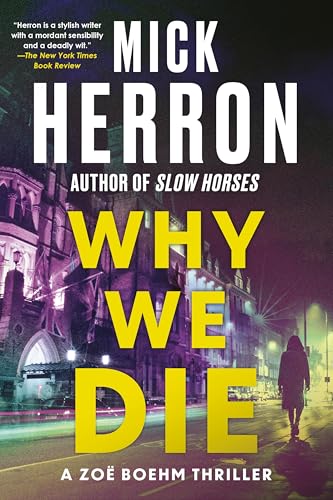
In Why We Die, financial pressure pushes Zoë into what appears to be a relatively straightforward investigation of a jewelry-shop robbery. The case soon becomes tangled with a far stranger collection of people, including a suicidal widower, a battered woman, dangerous brothers, and motives that do not align cleanly with the original crime. The novel demonstrates Herron’s preference for plots in which apparently minor decisions expose larger networks of desperation and violence. Zoë’s professional competence matters, but so does her vulnerability to misreading people whose secrets are more complicated than they first appear.
The concluding novel, Smoke and Whispers, alters the balance again when a body recovered from the River Tyne is identified as Zoë. Sarah Tucker travels to Newcastle and begins asking whether the death was suicide, murder, or the consequence of an old case. The return of earlier connections gives the finale a strongly cumulative quality, bringing the relationship between Sarah and Zoë back to the foreground and reinforcing how closely the four books are linked by personal history.
Although often described as the Zoë Boehm thrillers, the sequence is therefore broader than a standard private-detective series. Sarah Tucker is fundamental to both its beginning and later development, while Zoë’s investigations repeatedly draw private lives into larger structures of corruption and concealed power. The books also provide a revealing bridge to Herron’s later work: long before Slough House, he was already interested in failed systems, compromised authorities, sharp dialogue, abrupt reversals, and ordinary people discovering that official versions of events are rarely the whole truth.