
Below is the complete list of Dale Brown’s Nick Flynn books in order. For this series, the chronological reading order is the same as the order of publication.
Publication Order of Nick Flynn Books
with Patrick Larkin



About Nick Flynn
Dale Brown’s Nick Flynn series shifts his military-thriller formula away from the long-running McLanahan continuity and toward a younger intelligence operative working inside modern, deniable conflicts. The novels retain Brown’s fascination with advanced aircraft, strategic weapons, surveillance systems, and geopolitical brinkmanship, but their structure is more compact and field-oriented. Nick is rarely commanding a conventional military campaign from a secure operations center. He is usually close to the threat, operating with limited support while trying to determine what hostile governments and private actors are preparing before the United States recognizes the danger.
Nicholas Flynn begins Arctic Storm Rising as a U.S. Air Force intelligence officer whose career has been damaged by a failed CIA mission. Reassigned to a remote radar installation on Alaska’s northern frontier, he appears to have been placed where he can cause no further trouble. That punishment becomes unexpectedly important when Russian aircraft penetrate American airspace and a highly classified stealth bomber disappears in the Alaskan wilderness. Flynn and the personnel under his command are forced into an unforgiving contest with Russian special-forces troops amid extreme cold, poor communications, internal suspicion, and the possibility that the missing aircraft carries weapons capable of causing a national crisis.
Flynn’s defining quality is his refusal to remain within the passive role assigned to him. He is quick-thinking, irreverent, and willing to disregard procedure when evidence suggests that senior officials have misunderstood a threat. His confidence can appear reckless, but it is supported by strong instincts for intelligence analysis and field survival. He is most effective when plans break down and formal chains of command become obstacles rather than sources of protection.
The first novel also introduces Laura Van Horn, who becomes Flynn’s most important operational partner. Capable, daring, and comfortable with covert violence, Laura complements his improvisational approach without simply following his lead. Their developing trust gives continuity to a sequence otherwise driven by changing locations and weapons systems. Together they become part of the Quartet Directorate, a private intelligence organization with Cold War origins and the resources to act beyond the restrictions imposed on government agencies.
That transition changes the scale of the series. In Countdown to Midnight, Flynn is no longer an exiled officer guarding an Arctic outpost. He is operating internationally against a secret Russian-Iranian weapons project, with the investigation moving from an ambush in the Austrian Alps toward a plot involving a modified tanker and catastrophic strategic ambitions. The novel establishes Russian oligarch Pavel Voronin and his Raven Syndicate as the principal continuing adversaries.
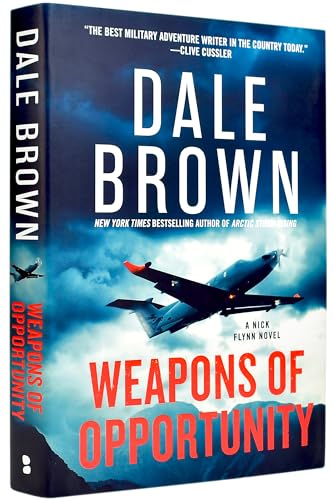
Voronin’s campaign extends through Weapons of Opportunity, where the threat reaches American territory through nuclear-armed attack drones and cooperation with a Mexican cartel. The conflict is no longer a single intelligence puzzle but a sustained private war between the Quartet Directorate and an organization able to combine Russian military technology, criminal networks, assassins, and political influence. Flynn and Laura must repeatedly act before conventional authorities possess enough evidence to intervene.
The Devil’s Fortress brings that conflict to its direct conclusion. Rather than waiting for another Voronin operation to develop, Flynn leads an assault against the oligarch’s heavily defended base. The shift from disrupting attacks to eliminating their source gives the final novel a more openly offensive structure and resolves the struggle developed across the previous books.
The four published novels form one connected arc and are best read sequentially. Flynn’s professional position changes, the Quartet team takes shape, and Voronin’s plans escalate through consequences established in earlier installments. Although the series is credited to Dale Brown, Patrick Larkin collaborated on the novels. Their combined approach delivers a streamlined branch of Brown’s military fiction in which private intelligence, covert action, and plausible near-future weaponry matter as much as aerial combat.