
Below is the complete list of Holly Jackson’s A Good Girl’s Guide to Murder books in order. For this series, the chronological reading order is the same as the order of publication.
Publication Order of A Good Girl’s Guide to Murder Books
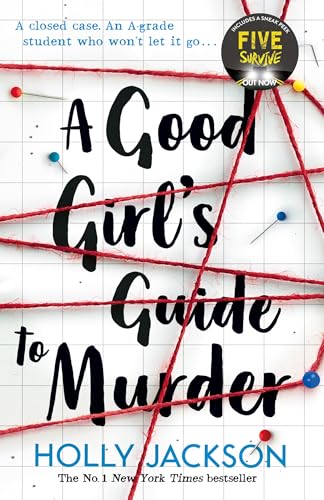


About A Good Girl’s Guide to Murder
Holly Jackson’s A Good Girl’s Guide to Murder series is a young adult mystery-thriller sequence centered on Pippa “Pip” Fitz-Amobi, a highly driven student whose investigation of a supposedly solved murder gradually changes her relationship with crime, justice, and her own community. The core trilogy begins with A Good Girl’s Guide to Murder, continues with Good Girl, Bad Blood, and concludes with As Good as Dead. Jackson also wrote Kill Joy, a prequel novella set before Pip becomes involved in the case that launches the main series.
The first novel begins with a crime everyone around Pip believes has already been solved. Five years earlier, schoolgirl Andie Bell disappeared, and her boyfriend, Sal Singh, was blamed for killing her before dying by suicide. The case has become accepted local history, but Pip has personal reasons for doubting that Sal was capable of murder. She chooses the case for a school project and begins reexamining the evidence.
Her investigation brings her together with Sal’s younger brother, Ravi Singh. Ravi has spent years living with the consequences of his brother being remembered as a murderer, and his knowledge of Sal gives Pip a perspective missing from the official narrative. Their partnership becomes one of the central relationships of the series as they interview people connected to Andie, reconstruct timelines, and discover that the apparently straightforward case contains secrets involving far more people than Pip expected.
Jackson gives the investigation a documentary quality through interview transcripts, notes, diagrams, messages, and other materials incorporated into the narrative. This format reflects Pip’s methodical approach while allowing readers to examine pieces of evidence alongside her. It also establishes a recurring concern of the series: there can be a substantial difference between what happened and the story a community has collectively decided to believe.
Good Girl, Bad Blood examines the consequences of Pip’s first investigation rather than simply giving her another unrelated puzzle. She initially intends to stop investigating, but a new disappearance involving someone close to her circle makes remaining uninvolved increasingly difficult. Her true-crime podcast gives the case a public dimension, bringing both useful information and the pressures that come with turning real suffering into material consumed by an audience.
The final novel, As Good as Dead, takes the series in a considerably darker direction. Pip is no longer the comparatively detached student who began researching an old case. Previous investigations have left her traumatized, distrustful, and increasingly aware of the gap between legal justice and what she believes to be morally right. When threatening messages suggest that someone may be stalking her, the distinction between investigator and potential victim begins to collapse.
Kill Joy takes place before those events and shows Pip attending a 1920s-themed murder-mystery party. The stakes are deliberately smaller, but the novella provides an early look at the persistence, competitiveness, and analytical habits that later make her such an effective investigator. Because it was published after the first novels, it can be read either as a prequel or in publication order.
The series is especially cohesive because Pip does not reset emotionally between books. Solving a mystery has consequences, exposure to violence changes her, and decisions made in one installment shape what she is capable of doing in the next. Ravi likewise develops from an investigative partner connected to the original case into someone deeply involved in Pip’s life and choices.
A Good Girl’s Guide to Murder therefore evolves from a cold-case investigation into a broader examination of what repeated contact with violence does to the person determined to uncover it. Pip begins by asking whether everyone was wrong about one murder. By the end, Jackson has turned that question into something much more difficult: what happens when discovering the truth no longer guarantees that justice will follow.