
Below is the complete list of Matt Dinniman’s The Shivered Sky books in order. For this series, the chronological reading order is the same as the order of publication.
Publication Order of The Shivered Sky Books


About The Shivered Sky
Matt Dinniman’s The Shivered Sky is a completed fantasy-horror saga set not in the living world but in a catastrophic version of the afterlife. Heaven has fallen, most of its angels have been destroyed, demons control much of what remains, and dead humans who expected paradise instead discover another existence governed by violence and enslavement. Against that setting, Dinniman follows Indigo and a widening cast of humans, angels, and demons caught in a war whose consequences extend far beyond simple survival.
The project has an unusual publication history. The Shivered Sky originally appeared in 2003 as a single novel. Dinniman later republished the story in 2020 as three separate parts: Every Grain of Sand, In the City of Demons, and The Great Devouring Darkness. The complete story has also been available in omnibus form, so readers may encounter either the original single-volume presentation or the later three-book structure. The underlying narrative is one continuous saga rather than three unrelated adventures.
Every Grain of Sand introduces Indigo after her death. She awakens with incomplete memories and quickly discovers that the reassuring ideas she once associated with an afterlife bear little resemblance to reality. Heaven is devastated, God is absent, surviving angels have been driven close to extinction, and humans captured by demons are treated as property. Indigo joins other human survivors in a resistance that has little reason to believe it can actually win.
That opening establishes the series’ deliberately bleak theology. Dinniman borrows imagery and concepts associated with angels, demons, Heaven, and divine warfare without constructing a traditional religious allegory. His afterlife is closer to an enormous dark-fantasy battlefield populated by rival species and factions, each possessing its own interests, hierarchies, and internal conflicts.
The perspective also extends beyond Indigo. Humans remain emotionally important because they have entered this world with little understanding of it, but Dinniman moves between human, angelic, and demonic viewpoints. That broader structure prevents the conflict from becoming a simple progression in which purely good angels fight uniformly evil demons. Power struggles and competing motivations exist within the occupying forces as well as among those resisting them.
In the City of Demons develops the aftermath of major losses suffered by the surviving angelic forces. Indigo and her companions become scattered and increasingly desperate, while the scale of the conflict expands deeper into territory controlled by their enemies. The middle section functions less as a reset than as the escalation expected from the second act of one large story: alliances shift, survival becomes more precarious, and the characters learn more about the forces shaping the ruined afterlife.
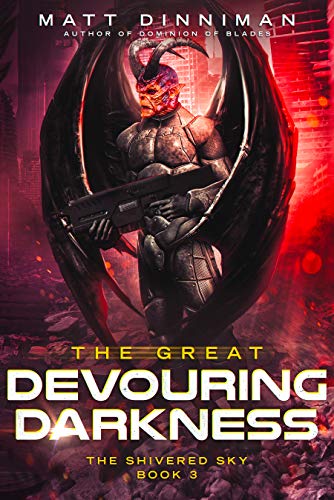
The Great Devouring Darkness brings those conflicts toward a final war. By this point the struggle has grown beyond Indigo’s initial attempt to understand where she has awakened. Rival powers are moving toward a confrontation in which control of the afterlife itself is at stake, giving the final section a markedly larger scale than the personal survival story at the beginning.
Readers coming to The Shivered Sky after Dungeon Crawler Carl will find a noticeably different Matt Dinniman. The later series relies heavily on absurd comedy and game mechanics, while The Shivered Sky is more directly rooted in epic fantasy, horror, grotesque imagery, and apocalyptic warfare. Yet some familiar interests are already present: ordinary people trapped inside enormous systems, powerful groups treating weaker beings as expendable, alliances formed under extreme pressure, and characters discovering that survival may eventually require challenging the structure controlling their world rather than merely enduring it.