
Below is the complete list of Bernard Cornwell’s Sharpe books in order. For this series, the chronological reading order is the same as the order of publication.
Publication Order of Sharpe Books


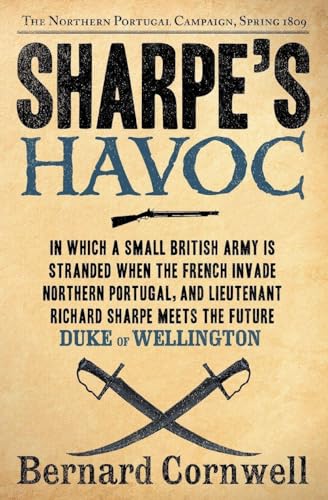



Publication Order of Sharpe Non-Fiction Books

About Sharpe
Richard Sharpe’s military career carries Bernard Cornwell’s longest-running series across nearly two decades of Napoleonic warfare, beginning with a resentful private soldier in British India and eventually placing him amid the chaos of Waterloo and its aftermath. Sharpe is not a gentleman officer in the conventional sense: he rises from the ranks through battlefield ability, determination, luck, and an instinct for survival, while repeatedly confronting an army in which class and patronage can matter almost as much as courage. That conflict between merit and privilege gives the novels a continuity extending far beyond their individual campaigns.
Cornwell actually introduced Sharpe midway through his life. Sharpe’s Eagle, published in 1981, places him in Spain during the 1809 Battle of Talavera, already an officer and an experienced soldier. The early published novels then followed his service through the Peninsular War toward Napoleon’s defeat, Waterloo, and later adventures.
Years afterward, Cornwell began filling the substantial gaps in Sharpe’s past. Sharpe’s Tiger, Sharpe’s Triumph, and Sharpe’s Fortress take him back to India between 1799 and 1803, when he serves as an enlisted man under officers including Arthur Wellesley, the future Duke of Wellington. These books explain much about the older Sharpe: his distrust of authority, hatred of Sergeant Obadiah Hakeswill, proficiency with weapons, and unlikely path toward becoming an officer.
From India, the story expands through Trafalgar, Copenhagen, Portugal, and Spain. The Peninsular War provides the heart of the saga, bringing Sharpe into battles and sieges at places such as Talavera, Bussaco, Barrosa, Fuentes de Oñoro, Badajoz, Salamanca, and Vitoria. Patrick Harper, Sharpe’s Irish comrade and closest friend, becomes one of the series’ indispensable characters, while recurring allies and enemies give the long sequence a sense of continuity despite its constantly changing campaigns.
Cornwell commonly builds each novel around genuine military events while allowing Sharpe to occupy the dangerous space between documented history and invention. Wellington and other historical commanders retain their real strategic roles; Sharpe usually operates closer to the ground, where victory depends upon riflemen, infantry formations, cavalry, artillery, supply problems, discipline, and soldiers trying not to be killed. Cornwell’s battlefield writing is particularly effective because geography matters: hills, roads, walls, bridges, weather, and formations determine what characters can realistically accomplish.
The chronology has continued to evolve long after the original sequence appeared. Sharpe’s Assassin returned to the immediate aftermath of Waterloo and the Allied occupation of Paris, while Sharpe’s Command inserted another adventure into the Spanish campaign of 1812. Sharpe’s Storm, published in 2025, fits between Sharpe’s Regiment and Sharpe’s Siege, returning Sharpe to fighting in southern France during the closing stages of the Peninsular War. Cornwell has indicated that it may prove to be Sharpe’s final full-length adventure, although he has stopped short of making an absolute promise never to revisit the character.
Several shorter works sit around the novels as well. Sharpe’s Skirmish takes place in 1812, while Sharpe’s Christmas contains stories from different points in Sharpe’s life. Sharpe’s Story is Cornwell’s nonfiction account of how the series developed rather than another adventure.
The unusual writing history means Sharpe can be approached either as Cornwell created him or according to the character’s internal chronology. Whichever route is chosen, the larger arc remains compelling: a poor London boy forces his way through one of Europe’s most rigid institutions and becomes an exceptional soldier without ever becoming entirely comfortable with the establishment that promoted him. Sharpe’s victories are memorable, but his enduring character comes from that tension between officer and outsider, making his career as much a battle against class and convention as against Napoleon’s armies.