
Below is the complete list of Bernard Cornwell’s The Last Kingdom books in order. For this series, the chronological reading order is the same as the order of publication.
Publication Order of The Last Kingdom Books
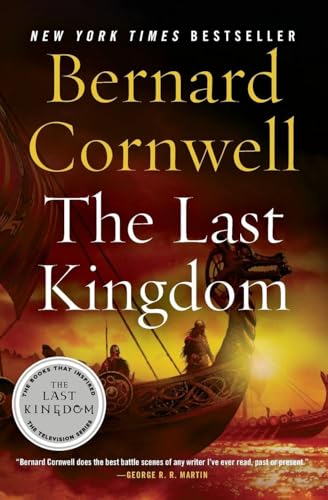






About The Last Kingdom
Bernard Cornwell’s Last Kingdom series follows Uhtred of Bebbanburg through the wars that transformed the divided kingdoms of ninth- and tenth-century Britain into something recognizably approaching England. Originally known as the Saxon Stories—and at times the Warrior Chronicles—the thirteen-novel sequence combines Uhtred’s fictional life with the reigns of Alfred the Great and his descendants. It is both a long military adventure and a study of divided identity, with Uhtred continually caught between the Saxon world into which he was born and the Danish culture that raised him.
The Last Kingdom introduces Uhtred as the son of a Northumbrian nobleman whose family holds Bebbanburg, the fortress that remains his greatest obsession throughout the saga. Captured as a child by the Danish warrior Ragnar, Uhtred grows up among the Danes and comes to admire their religion, freedom, and warrior culture. Circumstances eventually force him toward Wessex, where Alfred is struggling to preserve the last major Saxon kingdom not already overwhelmed by Danish conquest.
Uhtred and Alfred form one of Cornwell’s most productive relationships precisely because they rarely understand one another. Alfred is devout, disciplined, politically farsighted, and determined to create a unified Christian kingdom. Uhtred is pagan, impatient with priests, contemptuous of excessive caution, and happiest when battle can be solved with swords and shield walls. Yet Alfred repeatedly needs Uhtred’s military ability, while Uhtred depends upon Saxon kings for the men, wealth, and political support that might eventually help him reclaim Bebbanburg.
The early novels move through Alfred’s struggle for survival, including the Danish conquest of much of England and the West Saxon recovery that culminates around the Battle of Edington. As Uhtred grows older, the story broadens beyond Alfred himself. Edward succeeds his father in Wessex, Æthelflæd becomes a formidable ruler in Mercia, and the political project of joining the Saxon kingdoms continues even when the people pursuing it disagree about how that future should look.
Uhtred’s personal story develops alongside this national transformation. Bebbanburg remains the lost home toward which he repeatedly turns, but oaths, friendships, marriages, children, enemies, and obligations continually draw him elsewhere. Characters such as Finan become enduring companions, while successive generations of Danish and Norse warriors ensure that victory in one campaign rarely produces lasting peace.
Cornwell’s battles are rooted in the practical realities of early medieval warfare. Shield walls, fortifications, river crossings, ships, terrain, exhaustion, and discipline matter more than romantic heroics. Uhtred may be an exceptional fighter, but the novels consistently show that survival depends upon cohesion and luck as much as individual skill.
By the later books, age becomes increasingly important. Uhtred has survived long enough to watch younger warriors inherit conflicts he once considered his own. His eventual return to Bebbanburg resolves one of the saga’s defining ambitions, but England itself remains unfinished. Sword of Kings and the concluding War Lord carry him into the struggle surrounding Æthelstan and the decisive Battle of Brunanburh in 937, traditionally regarded as a crucial moment in the consolidation of the English kingdom.
The thirteen novels therefore achieve something broader than a conventional Viking adventure. Through one stubborn pagan warrior who never fits comfortably into the nation he helps create, Cornwell charts the slow replacement of competing kingdoms by England. Uhtred spends much of his life insisting that destiny is everything, yet the saga repeatedly shows history emerging from less predictable forces: loyalty, accident, ambition, betrayal, and people fighting for futures they will not necessarily live to see.