
Below is the complete list of Neil Gaiman’s Marvel 1602 books in order. For this series, the chronological reading order is the same as the order of publication.
Publication Order of Marvel 1602 Books
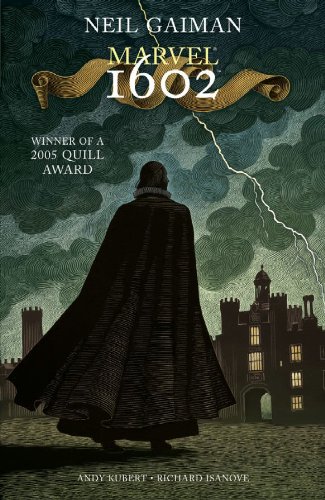

About Marvel 1602
What if Marvel’s greatest superheroes had appeared four centuries before their time, in an England governed by Queen Elizabeth I? Neil Gaiman explores this premise in Marvel 1602, an eight-issue comic book series originally published between 2003 and 2004. Combining Elizabethan history, political intrigue, supernatural mystery, and familiar Marvel characters, the story reimagines the superhero universe through the beliefs, conflicts, and social structures of the early seventeenth century.
The narrative unfolds in 1602, when England faces an increasingly disturbing series of events. Unnatural storms threaten the country, strange phenomena challenge accepted explanations, and rumours spread about individuals possessing extraordinary powers. Queen Elizabeth’s government fears that these disturbances may signal an approaching catastrophe.
Sir Nicholas Fury, the Queen’s intelligence chief, becomes deeply involved in investigating the threat. His position resembles that of his modern Marvel counterpart, Nick Fury, although he operates through royal espionage rather than an advanced intelligence agency. Working alongside him is Doctor Stephen Strange, the Queen’s physician and a practitioner of mysterious arts who suspects that the disturbances have origins beyond conventional understanding.
The story introduces numerous familiar superheroes in historically transformed roles. Peter Parquagh, an intelligent young man serving as Fury’s assistant, represents an early version of Peter Parker. Carlos Javier operates a school for young people possessing extraordinary abilities, whose existence makes them targets of fear and religious persecution.
These individuals, known as witchbreed, face hostility from authorities who regard their powers as dangerous or unnatural. Their persecution parallels the discrimination experienced by mutants in traditional X-Men stories, but Gaiman places that conflict within a society shaped by religious intolerance and suspicion of witchcraft.
Other recognisable figures include Matthew Murdoch, a blind Irish adventurer whose extraordinary senses make him a formidable operative, and the mysterious Four from the Fantastick, explorers whose unusual abilities have drawn the attention of powerful enemies.
A particularly important character is Virginia Dare, based on the historical child associated with England’s lost Roanoke colony. Her presence connects the supernatural mystery to English exploration of the Americas, while her unusual abilities become significant to the unfolding crisis.
Gaiman’s approach goes beyond dressing modern superheroes in period costumes. Their identities, occupations, and relationships are adapted to the political and cultural realities of the setting. Scientific concepts become difficult to distinguish from magic, while familiar superhero rivalries take the form of religious persecution, royal conspiracies, and struggles between competing powers.
The artwork by Andy Kubert, with digital painting by Richard Isanove, contributes significantly to the series’ atmosphere. Elaborate costumes, historical architecture, and dramatic landscapes establish a world that feels both recognisably Marvel and convincingly removed from its usual modern setting. Scott McKowen’s distinctive covers reinforce the historical presentation through illustrations inspired by traditional engraving techniques.
The original story develops into a mystery concerning the disruption of reality itself. Its resolution explains why recognisable Marvel characters have appeared in this historical period, connecting the apparent alternative history to the wider superhero universe.
Following the success of Gaiman’s original series, Marvel expanded the setting through several sequels written by other creators. Marvel 1602: New World (2005), written by Greg Pak, explores the consequences of the original events in colonial America, introducing further interpretations of familiar characters, including the Hulk and Iron Man.
Peter David continued the setting with Marvel 1602: Fantastick Four (2006), which follows the period’s version of the Fantastic Four through an adventure involving Otto von Doom, Atlantis, and William Shakespeare. Jeff Parker later wrote Spider-Man: 1602 (2009), developing Peter Parquagh’s superhero identity within the same historical universe.
The setting subsequently inspired 1602: Witch Hunter Angela (2015), written by Marguerite Bennett and Kieron Gillen. This later interpretation formed part of Marvel’s Secret Wars event and belongs to its Battleworld setting rather than serving as a straightforward continuation of Gaiman’s original narrative.
These distinctions are important because Neil Gaiman wrote the original eight-issue series, not the subsequent Marvel 1602 spin-offs. Collected editions also sometimes combine multiple miniseries, meaning similarly titled volumes may contain previously published material.
The appeal of Marvel 1602 lies in its imaginative reconstruction of a familiar fictional universe. By removing modern technology and placing superheroes within an era of religious conflict, exploration, and political uncertainty, Gaiman reveals how their defining qualities can survive dramatic changes in historical circumstances. The result is a distinctive fusion of superhero adventure and historical fantasy, shaped by questions of identity, persecution, and the unpredictable consequences of altering time.