
Below is the complete list of L. Frank Baum’s Oz books in order. For this series, the chronological reading order is the same as the order of publication.
Publication Order of Oz Books


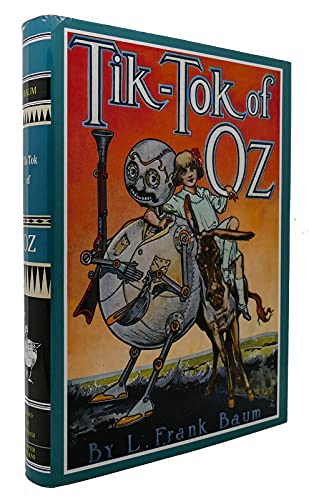


Publication Order of Oz Children’s Books

- TikTok and the Nome King (1913)
Published in 1913, TikTok and the Nome King is listed as book #2 in the Oz Children’s series.
Publication Order of Oz Collections Books


About Oz
The Land of Oz is one of the most enduring creations in American children’s fantasy, a magical kingdom where talking animals, enchanted objects, unusual creatures, and extraordinary adventures exist beyond the familiar world. Created by L. Frank Baum, the series began with The Wonderful Wizard of Oz in 1900 and grew into an elaborate fictional universe filled with distinctive characters, interconnected kingdoms, and imaginative landscapes. Baum wrote fourteen Oz novels, establishing a literary world that continued to expand long after his death and became a foundation of modern American fantasy literature.
The original novel introduces Dorothy Gale, a young girl from Kansas who is carried by a cyclone into the magical Land of Oz. Accompanied by her dog Toto, Dorothy encounters the Scarecrow, Tin Woodman, and Cowardly Lion, each seeking something they believe is missing from their lives. Their journey toward the Emerald City establishes the series’ characteristic combination of adventure, friendship, humor, and the discovery that courage, intelligence, and compassion often exist where they are least expected.
Although Dorothy remains one of the best-known characters, the series gradually develops into a much broader exploration of Oz and its inhabitants. The Marvelous Land of Oz shifts attention to a boy named Tip, whose adventures introduce important figures such as Jack Pumpkinhead, the Sawhorse, and the highly magnified Woggle-Bug. It also establishes Princess Ozma, whose identity and eventual leadership become central to the kingdom’s continuing history.
Ozma’s reign transforms Oz into a more unified and peaceful fairyland, allowing subsequent stories to explore its unusual geography, customs, and magical inhabitants. The Emerald City becomes the political and social center of a kingdom surrounded by distinctive territories, including the lands of the Munchkins, Winkies, Quadlings, and Gillikins. Beyond these regions lie other extraordinary countries whose inhabitants possess unfamiliar traditions and supernatural abilities.
Dorothy’s relationship with Oz also changes considerably. What begins as an unexpected journey into an unfamiliar world eventually develops into a lasting connection with its inhabitants. Her friendships with Ozma, the Scarecrow, the Tin Woodman, and other recurring characters provide continuity as the novels move between different protagonists and adventures.
Baum’s imagination is particularly evident in the remarkable variety of characters he introduces. The mechanical man Tik-Tok, the energetic Patchwork Girl, the living Gump, and the Hungry Tiger demonstrate his fascination with unconventional personalities and animated creations. Many characters possess peculiar limitations or exaggerated characteristics, yet their differences frequently become sources of humor, ingenuity, and unexpected friendship.
The series also develops its own increasingly elaborate magical rules. Oz is populated by witches, sorceresses, and other beings capable of extraordinary transformations, although the use of magic is eventually regulated under Ozma’s authority. These restrictions create opportunities for conflict when outsiders, ambitious rulers, or mischievous individuals attempt to challenge the kingdom’s stability.
Friendship and cooperation remain central throughout the novels. Even when characters possess powerful magical abilities, their success often depends on kindness, practical intelligence, and the willingness to help others. Baum frequently uses humor and playful reversals to question conventional ideas about bravery, wisdom, beauty, and authority.
The series’ development also reflects Baum’s changing relationship with his creation. He initially attempted to conclude the adventures with The Emerald City of Oz, but continued demand encouraged him to return to the magical kingdom. His later novels explore increasingly independent adventures while retaining familiar characters and established traditions.
Baum’s final Oz novel, Glinda of Oz, was published posthumously in 1920. The series subsequently continued under other writers, most notably Ruth Plumly Thompson, whose contributions helped expand the collection commonly known as the Famous Forty. These later works belong to the wider literary history of Oz but are distinct from Baum’s original fourteen novels.
The Oz stories also became notable for their illustrations, beginning with W. W. Denslow’s artwork for the first novel and continuing through John R. Neill’s contributions to later volumes. Their visual interpretations helped establish the distinctive appearance of Oz’s inhabitants and landscapes.
What makes Baum’s Oz remarkable is its combination of whimsical invention and an unusually welcoming vision of fantasy. Its characters are often peculiar, imperfect, or misunderstood, yet their differences contribute to the richness of the fictional world. Across fourteen novels, Baum created more than a succession of magical adventures: he established an imaginative kingdom whose enduring appeal rests on friendship, curiosity, humor, and the possibility of finding a place where one truly belongs.