
Below is the complete list of Martha Wells’ Murderbot Diaries books in order. For this series, the chronological reading order is the same as the order of publication.
Publication Order of Murderbot Diaries Books





About Murderbot Diaries
Martha Wells’s Murderbot Diaries is a science fiction series about a self-named SecUnit that has hacked its governor module, gained freedom of action, and mostly wants to be left alone to watch entertainment serials. That dry premise becomes the basis for one of modern science fiction’s most distinctive character studies. Murderbot is a lethal security construct built for corporate use, but the books are less interested in killer-robot spectacle than in autonomy, trauma, privacy, friendship, labor exploitation, and the awkward terror of being cared about.
The series begins with All Systems Red, which introduces Murderbot while it is assigned to protect a group of scientists on a survey mission. The job should be routine, but violence and sabotage expose both the brutality of the corporate world and Murderbot’s uneasy difference from the role it was built to perform. It is capable of extraordinary violence, but its private narration is defensive, funny, anxious, and deeply uncomfortable with human attention. Wells’s central achievement is voice: Murderbot’s sarcasm and emotional avoidance make it comic, but they also reveal a person trying to survive after being treated as equipment.
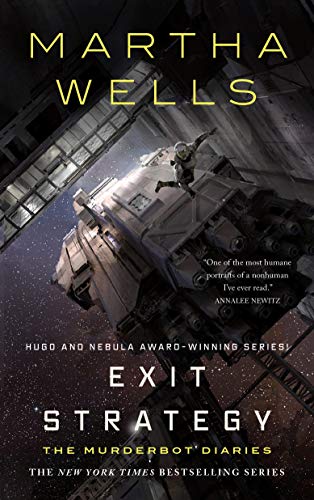
The first four novellas form a tight opening arc. Artificial Condition introduces ART, the powerful research transport whose intelligence, arrogance, and strange friendship with Murderbot become central to the wider series. Rogue Protocol and Exit Strategy expand Murderbot’s investigation into its own past, its memories of a massacre, and its changing connection to Dr. Mensah and the PreservationAux team. These books are compact, but they are strongly cumulative. Each mission pushes Murderbot farther from the corporate identity of a rented security unit and closer to the much harder problem of choosing what kind of person it wants to be.
Network Effect, the first full-length novel, broadens the scale while keeping the emotional pressure intimate. Murderbot is drawn into danger involving ART, alien remnants, kidnapping, and a larger web of corporate violence. The longer form allows Wells to deepen the relationships around Murderbot, especially with ART and the Preservation humans. The series’ action remains sharp, but its real tension often comes from moments of trust, panic, miscommunication, and unwanted vulnerability.
One structural point is worth noting because it can confuse readers after seeing the list. Fugitive Telemetry was published after Network Effect, but it takes place earlier in the internal timeline, during Murderbot’s time on Preservation Station. Its murder-mystery shape is different from the other books, placing Murderbot inside a more formal investigation while it tries to work with humans who do not fully understand it and authorities who do not know whether to trust it.
System Collapse continues directly from the aftermath of Network Effect, returning to the consequences of alien contamination, corporate extraction, and the messy work of helping colonists who are being manipulated by people with power. Murderbot’s emotional condition is especially important here. It is not simply becoming more heroic; it is dealing with damage, memory, and the difficulty of functioning after crisis. Platform Decay then continues the series into another post-System Collapse phase, keeping ART, Murderbot, and their expanding circle of obligations at the center of a world where no rescue is ever uncomplicated.
The Murderbot Diaries also includes short fiction and related pieces that add texture, but the main sequence carries the essential arc. Across the books, Wells turns a corporate security product into a narrator of startling emotional precision. Murderbot does not become human in any simplistic sense, nor does it need to. Its journey is about personhood on its own terms: the right to privacy, the right to refuse ownership, the right to build relationships badly and honestly, and the right to decide that survival can include both tactical competence and binge-watching shows in peace.