
Below is the complete list of James Dashner’s Maze Runner books in order. For this series, the chronological reading order is the same as the order of publication.
Publication Order of Maze Runner Books



Publication Order of Maze Runner Collections Books

Publication Order of Maze Cutter Books



About Maze Runner
James Dashner’s Maze Runner series begins as a survival mystery and gradually expands into a much larger dystopian history involving engineered environments, pandemic catastrophe, memory manipulation, and institutions willing to sacrifice individuals for a perceived greater good. The original trilogy follows Thomas, a teenager who arrives with almost no memory in the Glade, an enclosed settlement populated by boys who have built their own fragile society beside an enormous shifting maze. What initially appears to be a problem of escape becomes a confrontation with the forces that deliberately placed them there.
The Maze Runner establishes the series through restricted knowledge. Thomas knows little more than the reader, and the Gladers themselves understand only fragments of the system governing them. The Maze changes, monstrous Grievers patrol its corridors, supplies arrive by unexplained means, and no one knows why the experiment exists. The arrival of Teresa—the first girl sent into the Glade—accelerates the collapse of the established order and forces Thomas toward questions about his own connection to the place.
The original story broadens sharply in The Scorch Trials. Escape from the Maze does not bring freedom; instead, Thomas and the surviving Gladers confront WICKED, the organization behind the trials, and a devastated world transformed by solar flares and the Flare, a disease that attacks the brain. Dashner shifts the series from enclosed puzzle to hostile landscape, but the central uncertainty remains the same. Thomas is continually asked to decide whom to trust while information is withheld, memories are unreliable, and apparent allies may be acting under instructions he cannot see.
The Death Cure brings those tensions into open conflict. By this stage, the question is no longer simply whether Thomas can survive WICKED’s tests, but whether the organization’s stated mission can justify the methods it has used. Friendship becomes especially important because Thomas’s resistance is grounded less in an abstract political philosophy than in what he has watched happen to Newt, Minho, Teresa, and others treated as components of an experiment.
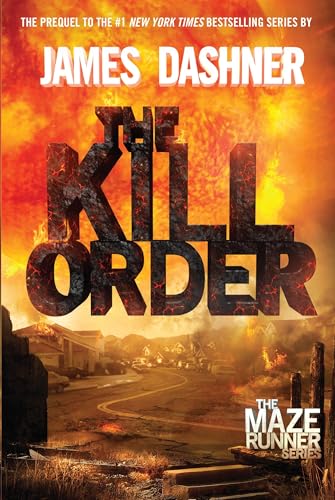
Dashner later moved backward in the chronology. The Kill Order is set before Thomas enters the Maze and follows different characters through the catastrophic period surrounding the solar flares and the spread of the Flare. The Fever Code moves closer to the original trilogy, exploring Thomas, Teresa, WICKED, and the creation of the Maze itself. These prequels answer questions deliberately left incomplete in the first three novels, but they also alter how certain decisions and relationships are understood.
The wider bibliography includes companion material that should not be confused with additional principal novels. The Maze Runner Files collects documents and other material connected to the world of WICKED. Crank Palace is a novella focused on Newt during events associated with The Death Cure, giving greater space to a character whose fate is one of the original trilogy’s most emotionally significant threads.
The universe later expanded through the Maze Cutter trilogy, beginning with The Maze Cutter. Set decades after the original events, it follows a later generation and examines the long consequences of the world Thomas and the other Gladers inherited and changed. The Godhead Complex continues that future conflict, while The Infinite Glade, published in 2025, completes the trilogy and brings the broader Maze Runner saga to another major endpoint. This later sequence is a continuation of the same world rather than a direct extension of Thomas’s original three-book journey.
Across its different phases, the series repeatedly returns to controlled knowledge. Characters are placed inside systems, told that suffering serves a necessary purpose, and forced to decide whether authority deserves trust simply because it claims to be protecting humanity. The Maze is the most famous expression of that idea, but the deeper pattern continues through WICKED, the Flare, the prequel history, and the later generation living with the consequences of decisions made long before them.