
Below is the complete list of Isaac Asimov’s Galactic Empire books in order. For this series, the chronological reading order is the same as the order of publication.
Publication Order of Galactic Empire Books


About Galactic Empire
Long before the decline of the Galactic Empire depicted in Isaac Asimov’s Foundation novels, humanity had already spread across countless planets, creating societies divided by political ambition, economic inequality, and competing visions of civilisation. The Galactic Empire series explores this earlier period of human expansion through three loosely connected science-fiction novels published between 1950 and 1952. Rather than following one continuing cast, the books portray different stages of galactic development, examining the forces that eventually produce the vast imperial civilisation central to Asimov’s future history.
The novels occupy an important position between Asimov’s Robot stories and the Foundation series. By the time their events unfold, humanity has established settlements far beyond Earth, and the political influence of individual planetary systems has begun developing into larger interstellar powers. Advanced technology makes travel between worlds possible, but it has not eliminated familiar human problems such as exploitation, prejudice, authoritarian government, and economic dependence.
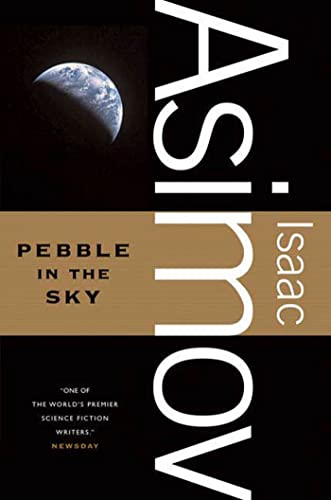
Pebble in the Sky (1950), Asimov’s first published novel, presents a future in which Earth has become an impoverished, radioactive planet regarded with contempt by much of the galaxy. Its population lives under severe restrictions while struggling to preserve memories of a distant past when Earth was humanity’s original home.
The story begins when Joseph Schwartz, an ordinary retired tailor living in twentieth-century Chicago, is accidentally transported thousands of years into the future. Unable to understand the language or customs of his new surroundings, Schwartz becomes entangled in a dangerous political conspiracy involving Earth’s relationship with the Galactic Empire.
His unusual circumstances provide an effective perspective on a civilisation that treats humanity’s birthplace as an insignificant and inferior world. Through Schwartz, Asimov examines historical memory, discrimination, and the consequences of allowing political resentment to develop into extremism.
The Stars, Like Dust (1951) takes place considerably earlier in the fictional timeline, before the establishment of a unified Galactic Empire. Its protagonist, Biron Farrill, is a young student whose life changes when he learns that his father has been executed for conspiring against the Tyranni, a powerful group ruling several planetary kingdoms near the Horsehead Nebula.
Forced to flee, Biron becomes involved with individuals resisting Tyranni authority. His experiences reveal the political fragility of a galaxy divided among competing rulers, where rebellion can emerge from personal grievances as readily as organised political movements.
The novel combines space adventure with conspiracy and questions about political freedom. Its title also appeared as The Rebellious Stars in an early paperback edition, a publishing variation that does not represent a separate story.
The Currents of Space (1952) shifts attention to Florina, an agricultural planet whose inhabitants produce kyrt, an exceptionally valuable material used throughout the galaxy. Despite the wealth generated by this resource, the planet’s population lives under the domination of the ruling Sarkites.
When a scientist discovers that a natural catastrophe may threaten Florina, his warning becomes entangled with political interests determined to protect their economic power. The resulting mystery involves lost memories, exploitation, and the struggle to establish the truth when influential groups benefit from suppressing it.
Of the three novels, The Currents of Space places particular emphasis on economic inequality and the relationship between planetary resources and political authority. It also portrays Trantor’s growing influence during the period preceding its eventual dominance of the galaxy.
The Galactic Empire novels differ substantially from the later Foundation books. Their narratives are more closely associated with individual protagonists, dangerous discoveries, and political conspiracies than with the mathematical prediction of historical developments. Nevertheless, they introduce important elements of Asimov’s wider fictional civilisation, particularly the rise of Trantor and Earth’s declining status.
The three stories were not originally conceived as a tightly integrated trilogy. Their association became stronger as Asimov developed connections among his previously independent science-fiction settings. A related short story, Blind Alley (1945), also belongs to this broad historical period but is not one of the three principal Empire novels.
Their internal chronology differs from their publication sequence, reflecting Asimov’s practice of exploring different periods within the same imagined future. Because the novels feature separate characters and largely independent conflicts, understanding their shared historical background matters more than treating them as consecutive episodes of one adventure.
The Galactic Empire series reveals Asimov’s early fascination with the relationship between technological advancement and social progress. Its societies possess extraordinary scientific capabilities, yet remain vulnerable to familiar patterns of oppression, political ambition, and intolerance. These contradictions anticipate the concerns of Foundation, where the survival of civilisation depends not simply on preserving technology, but on understanding the historical forces governing human societies.