
Below is the complete list of Colin Dexter’s Inspector Morse books in order. For this series, the chronological reading order is the same as the order of publication.
Publication Order of Inspector Morse Books


Publication Order of Inspector Morse Collections Books

About Inspector Morse
Colin Dexter’s Inspector Morse series is a compact thirteen-novel body of crime fiction in which intellectual brilliance is repeatedly complicated by pride, loneliness, misjudgment, and desire. Published from 1975 to 1999, the books follow Chief Inspector Morse of the Thames Valley Police through murder investigations centered largely on Oxford and its surrounding communities. The university city provides an ideal environment for Dexter’s interests: scholarship and status coexist with jealousy, secrecy, sexual entanglements, professional rivalries, and crimes whose apparent solutions often depend on what witnesses have misunderstood or deliberately concealed.
Morse first appears in Last Bus to Woodstock, already recognizable as an unconventional detective. He is highly educated, impatient with routine, fascinated by language, fond of classical music and real ale, and drawn to cryptic crosswords. His method is rarely a steady accumulation of facts leading neatly toward certainty. Instead, he forms theories, abandons them, revises timelines, seizes on verbal details, and sometimes becomes convinced by an elegant explanation that proves wrong. Dexter makes those errors part of the character’s intelligence rather than an interruption to it. Morse solves difficult cases because he can rethink them, not because his first judgment is infallible.
Sergeant Lewis gives the novels their essential counterbalance. More grounded and often more patient, Lewis must endure Morse’s abruptness while testing the inspector’s assumptions against practical evidence. Their partnership develops gradually, gaining emotional weight without becoming sentimental. Morse can be dismissive, secretive, and exasperating; Lewis can disagree with him and recognize his weaknesses while remaining deeply loyal. The contrast between Morse’s restless speculative mind and Lewis’s steadier presence becomes one of the series’ most durable pleasures.
Dexter’s mysteries frequently revolve around interpretation. The Silent World of Nicholas Quinn moves through the closed environment of an Oxford examinations body, while The Dead of Jericho draws Morse into a case complicated by his personal interest in a woman he has met. The Wench Is Dead departs strikingly from the usual structure by having an ailing Morse investigate a nineteenth-century murder from his hospital bed. The Way Through the Woods begins with the unresolved disappearance of a woman and develops through competing narratives about what may have happened to her. These variations show how freely Dexter could alter the immediate machinery of an investigation while retaining the same fascination with incomplete knowledge.
Oxford itself changes character from book to book. Colleges, pubs, suburban homes, hotels, churches, examination offices, hospitals, and nearby roads create a setting broader than the postcard image of dreaming spires. Dexter was particularly alert to institutions and hierarchies: who belongs, who feels excluded, who possesses information, and how education or professional standing can disguise ordinary vanity. His plots often exploit the distance between public respectability and private conduct.
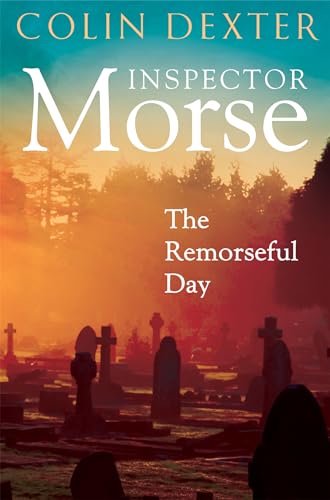
The series also carries more continuity than a sequence of isolated puzzles might initially suggest. Morse’s health, habits, relationships, and emotional vulnerabilities become increasingly important, and Lewis’s understanding of his superior deepens over time. Later novels assume familiarity with the man behind the detective persona. Death Is Now My Neighbour reveals significant personal information about Morse, while The Remorseful Day brings the series to a definitive conclusion rather than leaving its protagonist permanently unchanged.
There is a small bibliographical wrinkle beyond the thirteen principal novels. Morse also appears in shorter fiction, most notably stories collected in Morse’s Greatest Mystery and Other Stories. These pieces belong to the wider Morse bibliography but are distinct from the main novel sequence, which runs from Last Bus to Woodstock through The Remorseful Day.
The books also stand apart from the much larger screen universe that later grew around them. The television adaptations starring John Thaw became enormously influential, while Lewis and the prequel Endeavour expanded characters and histories far beyond Dexter’s thirteen novels. Those productions share the world of Morse, but they should not be treated as a direct map of the book continuity. Dexter’s original series remains tighter, more literary, and often more interested in the instability of reasoning itself: a detective mind solving crimes while never being entirely protected from its own errors.