
Below is the complete list of Eoin Colfer’s Artemis Fowl books in order. For this series, the chronological reading order is the same as the order of publication.
Publication Order of Artemis Fowl Books


Publication Order of Artemis Fowl Short Stories/Novellas Books


- Luna Minor (2019)
Luna Minor is a 2019 release and appears as book #3 in the Artemis Fowl Short Stories/Novellas series.


Publication Order of Artemis Fowl Collections Books
with Andrew Donkin, Matthew K. Manning
Publication Order of Artemis Fowl: The Graphic Novels Books
with Andrew Donkin


Publication Order of Artemis Fowl: The Graphic Novel (2) Books
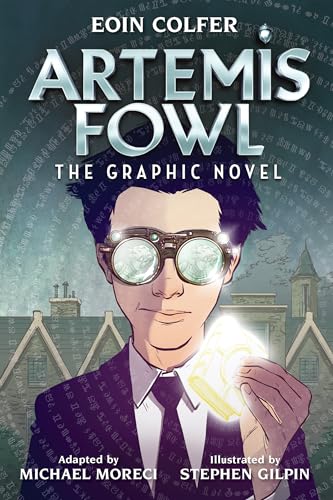
with Michael Moreci
About Artemis Fowl
Eoin Colfer’s Artemis Fowl series is a children’s fantasy-adventure sequence built around one of the genre’s most unusual heroes: a twelve-year-old Irish criminal mastermind who begins the story by trying to kidnap a fairy for ransom. The series starts with Artemis Fowl and develops across eight main novels, blending heist fiction, folklore, science fiction, spy adventure, family drama, and sharp comedy. Its central joke is also its great strength: Artemis enters the magical world not as a chosen savior, but as a calculating villain in a suit.
The first book introduces Artemis Fowl II as the heir to a fading criminal dynasty. Brilliant, arrogant, emotionally isolated, and determined to restore his family fortune, he discovers the existence of an underground fairy civilization and targets Captain Holly Short of the Lower Elements Police. That setup gives the series its distinctive energy. Colfer does not write fairies as delicate woodland figures. They are technologically advanced, militarized, bureaucratic, and often more practical than magical. The clash between Artemis’s human criminal intelligence and the fairy world’s science-driven magic makes the early books feel fresh and fast.
Holly Short is essential to the series’ success. As the first female captain in the LEP Recon unit, she is brave, impulsive, principled, and often furious at the systems around her. Her conflict with Artemis gradually turns into one of the series’ most important relationships. They begin as enemies, become reluctant allies, and eventually develop a complicated trust rooted in shared danger. Holly forces Artemis to confront the moral emptiness of his schemes, while Artemis repeatedly proves that his intelligence can be used for rescue rather than exploitation.
The supporting cast gives the books much of their comic and emotional range. Butler, Artemis’s bodyguard, brings loyalty, discipline, and physical danger into the human side of the story. Foaly, the paranoid centaur tech genius, supplies the fairy world’s gadgets and sarcasm. Commander Root adds authority and explosive temper, while Mulch Diggums, the thieving dwarf, brings some of Colfer’s broadest and strangest comedy. Opal Koboi becomes the series’ major recurring villain, a brilliant and unstable pixie whose ambition mirrors Artemis’s darker possibilities.
Publication order is the best way to read the main series because Artemis changes significantly over time. The early books, including The Arctic Incident, The Eternity Code, and The Opal Deception, continue the movement from criminal self-interest toward loyalty and responsibility. Later entries such as The Lost Colony, The Time Paradox, The Atlantis Complex, and The Last Guardian push the story into demons, time travel, psychological strain, ecological threat, and final confrontation. The plots are full of action and jokes, but the long arc is about conscience: whether a boy trained to win at any cost can learn that intelligence without empathy is only another form of damage.
The series also expands through graphic novel adaptations and the Fowl Twins books, which follow Artemis’s younger brothers, Myles and Beckett. Those spin-offs belong to the same world but have their own tone, built around sibling contrast, inherited chaos, and a younger generation dealing with fairy-world danger after Artemis’s main arc.
Artemis Fowl endures because it refuses to be only one thing. It is a fantasy series with computers, a crime series with trolls, a school-age adventure with moral consequences, and a redemption story that never lets its hero become bland. Artemis begins as a genius who thinks the world is a puzzle to be solved and exploited. The pleasure of the series is watching him discover, book by book, that some things are worth protecting even when they cannot be owned.