
Below is the complete list of James Herriot’s All Creatures Great and Small books in order. For this series, the chronological reading order is the same as the order of publication.
Publication Order of All Creatures Great and Small Books


Publication Order of All Creatures Great and Small Collections Books


About All Creatures Great and Small
James Herriot’s All Creatures Great and Small series is a beloved sequence of semi-autobiographical veterinary books drawn from the life and work of James Alfred Wight, the Yorkshire vet who wrote under the Herriot pen name. The books follow the young Herriot as he begins mixed veterinary practice in the fictional town of Darrowby, based closely on Thirsk in North Yorkshire, and gradually becomes part of the farming communities, households, roads, fields, kitchens, barns, and animal lives of the Yorkshire Dales.
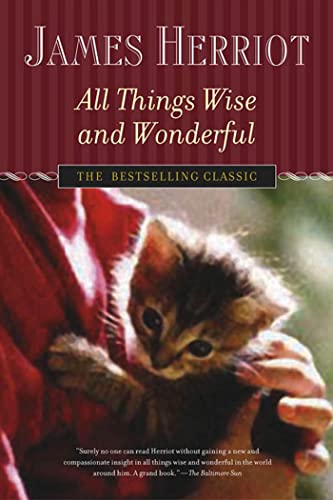
The series can be slightly confusing because the British and American editions were arranged differently. In the United Kingdom, Herriot’s early books appeared as shorter volumes, beginning with If Only They Could Talk and continuing through titles such as It Shouldn’t Happen to a Vet, Let Sleeping Vets Lie, Vet in Harness, Vets Might Fly, and Vet in a Spin. In the United States, several of those books were gathered into larger omnibus-style volumes with the now-famous titles All Creatures Great and Small, All Things Bright and Beautiful, and All Things Wise and Wonderful. Those American titles later became the most recognizable way many readers think of the series.
For practical reading, either arrangement works, but the omnibus order is often the simplest: All Creatures Great and Small, All Things Bright and Beautiful, All Things Wise and Wonderful, The Lord God Made Them All, and Every Living Thing. Read that way, the books form a warm, continuous portrait of Herriot’s professional and personal life: his arrival as an inexperienced assistant, his work with Siegfried and Tristan Farnon, his courtship and marriage to Helen, his wartime service, and his later years as an established vet looking back on the people and animals who shaped him.
The early books are especially rich in the comedy of apprenticeship. Herriot is capable and sincere, but he is repeatedly humbled by mud, weather, nervous owners, stubborn farmers, unpredictable animals, and the gap between veterinary training and real rural practice. A textbook case may become absurd when the patient is a kicking cow in a dark byre, a pampered dog with an anxious owner, or a horse whose size alone turns treatment into an athletic event. Herriot’s humor usually begins with embarrassment, but it rarely becomes cruel. He laughs at himself first.
Siegfried Farnon and Tristan Farnon give the series much of its shape. Siegfried, Herriot’s senior partner, is brilliant, generous, contradictory, and magnificently erratic. Tristan is charming, careless, and often comic, especially when study, responsibility, or punctuality are involved. Around them are farmers, housewives, innkeepers, aristocrats, children, bachelors, widows, and animal lovers of every kind. Herriot’s great skill is making even brief encounters feel memorable.
The animal stories are tender without being naïve. Herriot writes about birth, illness, injury, aging, recovery, and death with the eye of a working professional and the heart of someone who understood what animals mean to people. A cow may represent a farmer’s livelihood; a dog may be a lonely person’s closest companion; a cat may hold a household together in ways no one quite says aloud.
The All Creatures Great and Small books endure because they preserve a world of rural practice that has largely changed, while speaking to feelings that have not. They are about animals, but also about vocation, humility, marriage, community, memory, and care. Herriot’s gift was to show that ordinary work, done faithfully among ordinary people, could become a life full of stories.