
Below is the complete list of James Patterson’s Treasure Hunters books in order. For this series, the chronological reading order is the same as the order of publication.
Publication Order of Treasure Hunters Books
with Chris Grabenstein



About Treasure Hunters
James Patterson’s Treasure Hunters books are one of his most energetic middle-grade adventure series, built around a family that treats danger, history, and impossible missions as part of everyday life. Official Patterson checklist pages currently list nine main books in the series, from Treasure Hunters through The Greatest Treasure Hunt, and the line is consistently presented as a major ongoing children’s franchise rather than a one-off success. The books were written with Chris Grabenstein and illustrated by Juliana Neufeld, a combination that suits the series perfectly: fast chapters, lively humor, visual momentum, and a warm family core holding everything together.
At the center are the Kidd siblings, who live in a world where shipwrecks, stolen artifacts, missing parents, and global chases are not rare interruptions but the fabric of life itself. That family structure is the reason the series works as more than a collection of exotic adventures. The Kidds are not a team assembled for one mission. They are already a family with habits, rivalries, loyalties, and shared history, and the books draw much of their charm from that built-in chemistry. The treasure hunting matters, but the real engine is the feeling that these children have grown up inside a life of movement and risk, and have to rely on one another when adults fail, disappear, or leave them with mysteries too large to ignore.
The first book, Treasure Hunters, establishes that identity clearly. The Kidd parents vanish, and the children are suddenly pushed into a rescue-and-survival adventure that also functions as an initiation into the series’ larger rhythm. Patterson and Grabenstein do not treat treasure hunting as elegant historical tourism. In these books it is messy, funny, dangerous, and often tied to criminals, betrayals, and desperate escapes. That gives the series a stronger pulse than a gentler educational adventure line might have. The history and geography are exciting, but they are always tied to immediate peril.
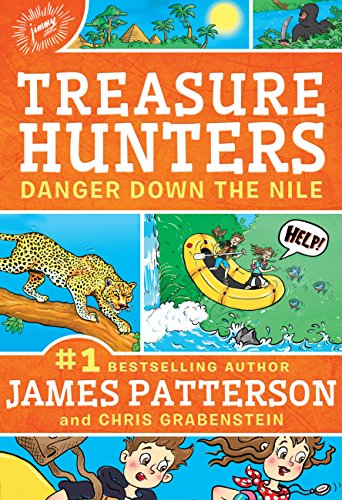
As the series continues through books such as Danger Down the Nile, Secret of the Forbidden City, Peril at the Top of the World, Quest for the City of Gold, and All-American Adventure, the pattern becomes clear: new corners of the world, new legendary objects or mysteries, and new tests for the Kidd family’s resilience. That globe-trotting structure is one of the line’s greatest strengths. It allows the books to stay fresh without abandoning their identity. Egypt, China, the Arctic, Australia, and other destinations are not just decorative backdrops. They help each book build its own atmosphere while preserving the larger sense that the Kidds live in a world where history is still active and still dangerous.
What keeps the series from becoming repetitive is tone. The books are adventurous, but they are also funny and affectionate in a way that prevents the danger from feeling too severe for their audience. The family banter matters. So does the pace. Patterson’s children’s fiction tends to move quickly, and here that works especially well because the premise thrives on momentum. Yet the books are not empty spectacle. The Kidd siblings’ affection, frustration, and improvisational teamwork give the adventures emotional shape.
Within Patterson’s middle-grade catalog, Treasure Hunters stands out because it combines family adventure, historical mystery, and world travel without losing readability. It is less school-based than I Funny, less science-driven than Max Einstein, and less purely comic than House of Robots. Its world is larger and more cinematic, but the human appeal remains simple: siblings trying to stay together while chasing answers across the globe. That is what gives the series its staying power. It offers shipwrecks, ancient secrets, and legendary treasure, but the real prize is the feeling of movement, family, and discovery that runs through every book.