
Below is the complete list of Sherrilyn Kenyon’s Lords Of Avalon books in order. For this series, the chronological reading order is the same as the order of publication.
Publication Order of Lords Of Avalon Books
as Kinley MacGregor


About Lords Of Avalon
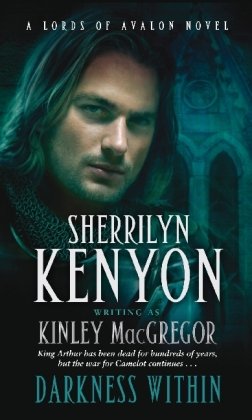
The Lords of Avalon series by Sherrilyn Kenyon is a dark Arthurian fantasy that reimagines the legendary kingdom of Camelot after the fall of King Arthur. Combining medieval adventure, Celtic mythology, supernatural conflict, and paranormal romance, the novels explore a world in which the ideals of the Round Table have been shattered and powerful enemies now control the kingdom. Originally published under Kenyon’s Kinley MacGregor pseudonym, the series eventually became an important part of her larger Dark-Hunter universe.
The story takes place after the disastrous Battle of Camlann, which brings Arthur’s reign to an end. With the king gone, his sister Morgen le Fey seizes control of Camelot, transforming the once-celebrated kingdom into a stronghold of dark magic. Demons, dangerous supernatural creatures, and corrupted warriors occupy positions previously held by Arthur’s knights, while a new Pendragon rules under Morgen’s influence.
Those who remain loyal to Arthur’s principles become the Lords of Avalon, a resistance determined to prevent Morgen from extending her dominion into the mortal world. Their struggle involves protecting powerful enchanted objects, confronting monstrous adversaries, and navigating treacherous alliances in a world where appearances rarely reveal someone’s true allegiance.
The conflict becomes particularly compelling in Sword of Darkness (2006), which introduces Kerrigan, the ruthless Pendragon ruling Camelot. Born into poverty and raised without affection, Kerrigan survives through cunning, violence, and ambition. His rise to power has made him one of Morgen’s most formidable allies, but his encounter with Seren, a humble seamstress, threatens the foundations of his carefully constructed identity.
Seren represents qualities Kerrigan has long dismissed as weaknesses: compassion, selflessness, and trust. Their relationship develops against the escalating conflict between Avalon’s defenders and Morgen’s forces, placing Kerrigan in a position where loyalty to his powerful benefactor conflicts with emotions he has never learned to understand.
The supernatural politics of Avalon become more intricate in Knight of Darkness (2006), which follows Varian duFey, the son of Lancelot and Narishka, Morgen’s powerful second-in-command. Rejected by both sides of his family, Varian has become a feared assassin whose formidable reputation conceals a lifetime of isolation and resentment.
His encounter with Merewyn, a woman condemned to centuries of suffering through a cruel magical bargain, forces him to confront the very people responsible for much of his misery. Their uneasy alliance illustrates Kenyon’s recurring fascination with damaged individuals who must learn to trust someone despite overwhelming reasons for suspicion.
Beyond these central relationships, Avalon possesses an elaborate magical hierarchy. Merlin is not simply the familiar wizard associated with Arthurian legend but a title held by powerful advisers to kings. The distinction between different Merlins, the authority of the Penmerlin, and the activities of the Fey introduce additional complexity to Camelot’s political and supernatural struggles.
Kenyon also incorporates legendary figures such as Lancelot alongside original characters whose histories expand the traditional Arthurian mythology. The resulting world is considerably darker than conventional tales of chivalry, with betrayal, curses, and competing supernatural bloodlines shaping the lives of its inhabitants.
Although Lords of Avalon began as a distinct Arthurian fantasy, its mythology gradually became intertwined with the Dark-Hunter and Were-Hunter stories. Later novels, including Son of No One, Dragonbane, and Dragonsworn, develop shared histories involving dragons, supernatural ancestry, and conflicts connecting Avalon’s medieval world to Kenyon’s broader fictional universe.
The series also inspired Marvel comic adaptations of Sword of Darkness and Knight of Darkness, bringing its interpretation of Camelot to a different storytelling medium.
One of the defining qualities of Lords of Avalon is its treatment of legendary heroism. Its protagonists are not invariably noble knights, and its villains are not always without redeeming qualities. Many characters occupy uncertain moral positions shaped by rejection, manipulation, or inherited obligations. Romance often becomes the catalyst that forces them to reconsider loyalties established through centuries of conflict.
Through its fallen kingdom, cursed warriors, and powerful magical factions, Lords of Avalon presents Arthurian legend as a continuing struggle rather than a completed heroic age. The ideals associated with Camelot survive not through an untarnished kingdom, but through individuals willing to challenge cruelty, resist corruption, and seek redemption despite the darkness surrounding them.