
Below is the complete list of James Lee Burke’s Dave Robicheaux books in order. For this series, the chronological reading order is the same as the order of publication.
Publication Order of Dave Robicheaux Books




About Dave Robicheaux
James Lee Burke’s Dave Robicheaux series is one of the great achievements of American crime fiction, a long, haunted sequence centered on a Louisiana lawman whose investigations are inseparable from memory, violence, addiction, faith, history, and the damaged beauty of the Gulf Coast. The series begins with The Neon Rain, introducing Dave as a Vietnam veteran and New Orleans police detective, and gradually roots him more deeply in New Iberia, Iberia Parish, and the bayou country that becomes the moral and atmospheric center of the novels.
Dave Robicheaux is not a detective in the tidy puzzle-solving tradition. He is a recovering alcoholic, a Catholic, a widower, a father, a former soldier, and a man continually at war with his own capacity for rage. His badge gives him authority, but his real burden is conscience. Burke writes Dave as someone who has seen evil in war, policing, prisons, politics, racism, organized crime, and ordinary human cruelty, yet still believes that decency matters even when it is battered, compromised, or late.
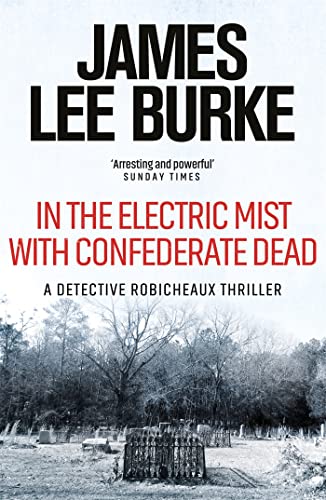
The early books establish the series’ essential tensions. The Neon Rain and Heaven’s Prisoners bring Dave into contact with corruption, criminal networks, and personal loss, while Black Cherry Blues gives the series its first major national recognition and deepens the emotional weight around Dave’s private life. As the novels continue through books such as A Morning for Flamingos, A Stained White Radiance, In the Electric Mist with Confederate Dead, Dixie City Jam, and Burning Angel, Burke expands the series into a broader examination of Louisiana’s history, class divisions, racial wounds, and political rot.
Clete Purcel is central to the series’ power. Dave’s former partner and closest friend, Clete is loyal, reckless, funny, violent, self-destructive, and often morally impossible to defend. Their friendship is one of Burke’s richest creations because it is rooted in shared trauma and mutual recognition. Dave often sees in Clete the part of himself that cannot be fully disciplined; Clete sees in Dave a man still trying to believe in grace. Together, they turn the series into something more emotionally volatile than a conventional police procedural.
The setting is as important as any recurring character. Burke’s Louisiana is beautiful and wounded: bayous, oak trees, rain, heat, oil money, decaying mansions, bars, churches, prisons, shrimp boats, and poor neighborhoods all carry historical pressure. The crimes Dave investigates are rarely isolated. A murder may open into old racism, land theft, political corruption, wartime trauma, environmental damage, family betrayal, or the long afterlife of violence that respectable people prefer to ignore.
Publication order is the best way to read the Dave Robicheaux novels because the cases are generally self-contained, but the emotional and moral accumulation matters. Dave’s family life, his relationship with Alafair, his struggle with alcohol, his losses, his faith, and his bond with Clete all deepen over time. Later books such as The Tin Roof Blowdown, The Glass Rainbow, Creole Belle, Light of the World, Robicheaux, and A Private Cathedral carry the weight of everything that has come before.
The Dave Robicheaux series endures because Burke writes crime as a spiritual and historical condition, not merely an event. His villains may be gangsters, killers, exploiters, or corrupt officials, but the deeper adversary is often despair: the temptation to believe that cruelty has already won. Dave keeps investigating because he cannot accept that. In Burke’s world, justice is imperfect, costly, and sometimes incomplete, but the refusal to stop seeking it is itself a form of grace.