
Below is the complete list of Adam Haslett books in order. For each series, the chronological reading order is the same as the order of publication.
Publication Order of Standalone Books


Publication Order of Short Stories/Novellas Books

Publication Order of Short Story Collections Books

Publication Order of Dark Corners Books


Publication Order of Selected Shorts Books

About Adam Haslett
Adam Haslett is an American novelist and short-story writer known for psychologically exact fiction about families, intimacy, mental illness, sexuality, grief, and the pressures that private histories exert across generations. Born in Rye, New York, in 1970, he studied English literature at Swarthmore College before earning an MFA from the Iowa Writers’ Workshop and a law degree from Yale. That combination of literary training and legal education is reflected in a career that has moved between fiction, journalism, teaching, and sustained engagement with social and political questions.
Haslett attracted major attention with his first book, the 2002 story collection You Are Not a Stranger Here. Its closely observed stories established many of the concerns that would continue through his novels: loneliness, emotional dependence, psychological instability, sexuality, and the difficulty of caring for people whose suffering cannot easily be resolved. The collection became a finalist for both the National Book Award and the Pulitzer Prize for Fiction, an unusually strong reception for a debut. Haslett later received the PEN/Malamud Award for his achievement in short fiction.
His first novel, Union Atlantic, appeared in 2010 and expanded his focus from intimate emotional life to questions of money, power, property, and institutional failure. The novel pits an ambitious young banker against an older retired teacher in a dispute that develops into a wider examination of financial culture and moral entitlement. Written around the period of the global financial crisis, it showed that Haslett could place his careful character work within a broader social framework. The novel won the Lambda Literary Award and was shortlisted for the Commonwealth Prize.
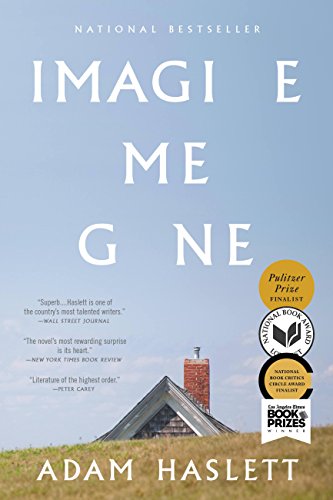
Imagine Me Gone brought family life back to the center of his fiction. Published in 2016, it follows a family across decades as depression and anxiety affect not only those directly experiencing them but the people who love and attempt to care for them. Haslett uses multiple viewpoints to make the family’s difficulties collective rather than reducing the story to a single character’s illness. The novel became his second Pulitzer Prize finalist, was a National Book Critics Circle Award finalist, and won the Los Angeles Times Book Prize for Fiction.
Nearly nine years later, Haslett returned with Mothers and Sons, published in 2025. The novel centers on Peter, a New York asylum lawyer, and his estranged mother, Ann, whose long separation is bound to a painful history they have avoided confronting. Immigration law, memory, sexuality, family estrangement, and the moral complications of helping others while remaining emotionally isolated all enter the story. Rather than representing a dramatic change of direction, the novel deepens Haslett’s longstanding interest in how people construct lives around experiences they cannot fully leave behind.
Haslett’s books appear at comparatively long intervals, and his bibliography remains compact beside those of many contemporaries. The continuity between them, however, is substantial. He favors interior, character-driven narratives in which emotional consequences accumulate gradually, often balancing painful material with wit and moments of unexpected tenderness. Families are especially important in his fiction, not simply as sources of belonging but as systems through which fear, responsibility, illness, secrecy, and love travel from one person to another.
Alongside his books, Haslett has published journalism and essays on culture and politics and has taught at institutions including the Iowa Writers’ Workshop and Columbia University. His work has also received fellowships and honors from organizations including the Guggenheim Foundation and the American Academy of Arts and Letters. Across four major works of fiction, he has established a distinctive body of writing in which psychological precision and social awareness remain closely intertwined.