
Below is the complete list of Neil Gaiman’s Sandman Graphic Novels books in order. For this series, the chronological reading order is the same as the order of publication.
Publication Order of Sandman Graphic Novels Books




Publication Order of Sandman Non-Fiction Books


About Sandman Graphic Novels
Dreams have their own kingdom, their own laws, and a ruler whose responsibilities extend far beyond the sleeping minds of humanity. In Neil Gaiman’s The Sandman, that ruler is Dream, also known as Morpheus, an ancient being whose attempts to understand change, responsibility, and personal freedom form the foundation of one of the most influential works in modern graphic literature. Originally published by DC Comics between 1989 and 1996, the main series spans 75 issues, subsequently collected into ten principal graphic novel volumes.
Morpheus belongs to the Endless, seven immortal siblings who embody fundamental aspects of existence: Destiny, Death, Dream, Destruction, Desire, Despair, and Delirium. Unlike conventional gods, the Endless represent forces that exist independently of human worship. Their relationships, rivalries, and obligations shape events across countless worlds, historical periods, and mythological traditions.
The narrative begins in Preludes & Nocturnes, when an occult ritual intended to capture Death instead imprisons Dream. His captivity lasts more than seventy years, leaving his realm, the Dreaming, in disarray. Upon escaping, Morpheus must recover stolen objects of power and restore his damaged kingdom.
His return establishes the series’ central tension. Dream possesses immense supernatural authority, yet he remains bound by ancient rules, personal pride, and an unwillingness to adapt. Although he can reshape dreams and influence entire worlds, he often struggles with the emotional complexities of his relationships.
The Dreaming itself is populated by memorable inhabitants, including Lucien, its librarian; Matthew, a talking raven; and various nightmares created to fulfil particular purposes. These characters provide continuity as the story moves between supernatural realms and ordinary human lives.
Gaiman gradually expands the narrative beyond Morpheus through interconnected stories involving mortals, immortals, historical figures, and mythological beings. The Doll’s House introduces Rose Walker, whose unusual connection to dreams threatens the boundaries separating sleeping minds. Season of Mists examines the consequences of Lucifer abandoning Hell, forcing Dream to confront competing gods and supernatural powers seeking control of the vacant realm.
Later volumes explore Morpheus’s personal history more directly. Brief Lives follows Dream and his sister Delirium as they search for their missing brother Destruction, revealing the conflicting attitudes of the Endless toward duty and change. The Kindly Ones brings longstanding grievances and earlier decisions into a devastating confrontation, while The Wake provides the emotional resolution to the central narrative.
One of the series’ defining characteristics is its literary ambition. Gaiman draws upon Greek mythology, Shakespeare, European folklore, religious traditions, and classic fantasy without treating these influences as belonging to a single historical period. Stories can move from ancient civilizations to contemporary cities, sometimes concentrating on characters whose connections to Morpheus only become apparent much later.
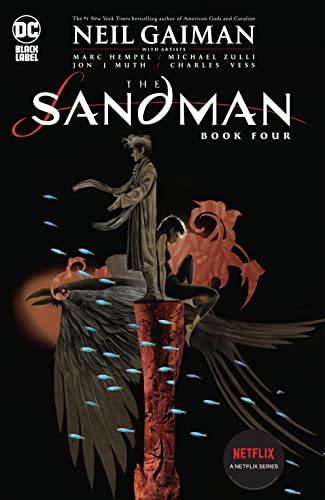
The visual storytelling is equally important. Artists including Sam Kieth, Mike Dringenberg, Kelley Jones, Jill Thompson, Marc Hempel, and Michael Zulli contributed distinctive interpretations of Gaiman’s fictional world. Dave McKean’s innovative covers further established the series’ unusual visual identity.
The original narrative received widespread critical recognition, including a World Fantasy Award for the Shakespeare-inspired story “A Midsummer Night’s Dream.”
Several companion works expand the mythology. The Sandman: Endless Nights (2003) presents seven illustrated stories, each devoted to a member of the Endless. The Sandman: The Dream Hunters explores a tale inspired by Japanese folklore and exists in both illustrated prose and graphic novel adaptations.
The Sandman: Overture, illustrated by J. H. Williams III, was published between 2013 and 2015. Although its events precede Dream’s imprisonment, the story draws upon knowledge established throughout the original series and reveals the circumstances leading to his capture.
The wider universe also includes Gaiman’s two Death miniseries, The High Cost of Living and The Time of Your Life, alongside numerous spin-offs developed by other creators. Different collected editions, including deluxe editions, omnibuses, and anniversary reprints, contain overlapping material rather than entirely new storylines.
At its heart, The Sandman is less concerned with defeating a single villain than with the consequences of choices accumulated across centuries. Morpheus can command the realm of dreams, but his greatest difficulty lies in understanding himself. Through his relationships with mortals and immortals alike, Gaiman creates a meditation on stories, mortality, transformation, and the painful necessity of change.