
Below is the complete list of Peter Swanson books in order. For each series, the chronological reading order is the same as the order of publication.
Publication Order of Henry Kimball / Lily Kintner Books


Publication Order of Standalone Books




Publication Order of Short Stories/Novellas Books


Publication Order of Bibliomysteries Books

About Peter Swanson
Peter Swanson is an American novelist best known for psychological suspense and crime fiction built around deception, obsession, murder, and characters whose motives are rarely as straightforward as they first appear. His books often draw on classic mystery traditions while using contemporary settings and morally ambiguous protagonists. He is particularly associated with The Kind Worth Killing, Eight Perfect Murders, The Kind Worth Saving, and the Henry Kimball novels, along with a growing body of standalones that frequently play with readers’ expectations about guilt and innocence.
Swanson was born in Concord, Massachusetts, and grew up in New England, a region that has become central to much of his fiction. He studied at Trinity College, the University of Massachusetts Amherst, and Emerson College, where he earned an MFA in creative writing. Before establishing himself as a novelist, he published poetry and short fiction and worked in a variety of jobs while continuing to write.
His debut novel, The Girl with a Clock for a Heart, was published in 2014. The book follows George Foss, whose seemingly settled life is disrupted when a woman from his college past suddenly reappears and asks for help. The novel immediately established Swanson’s interest in unreliable histories, dangerous attraction, and the way an old relationship can transform into a crime story.
His breakthrough came with The Kind Worth Killing in 2015. The novel begins with a chance encounter in an airport bar between Ted Severson and Lily Kintner, where a conversation about an unhappy marriage turns into discussion of murder. Swanson structures the story through shifting perspectives, gradually revealing that nearly everyone involved is concealing something. The novel earned strong critical attention and became one of his defining works.
Lily Kintner later returned in The Kind Worth Saving, while detective Henry Kimball also became an important recurring figure. Kimball first appears in The Kind Worth Killing and later takes a larger role in The Kind Worth Saving, creating a loose continuity within Swanson’s otherwise mostly standalone bibliography.
Her Every Fear continued his exploration of psychological vulnerability and dangerous strangers. The story follows Kate Priddy, who swaps apartments with a distant cousin and moves from London to Boston, only to find herself caught up in a murder investigation. Swanson again uses a familiar suspense device—temporary relocation—as a way to destabilize a protagonist and force her to question what she knows about the people around her.
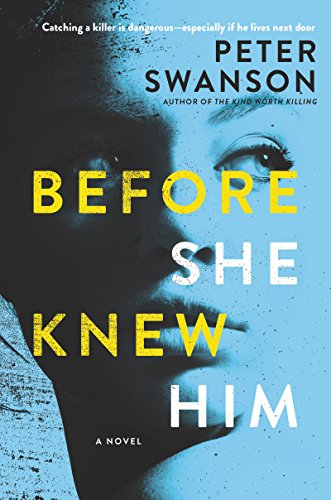
In Before She Knew Him, he turns to suburban suspicion. The novel centers on Hen Mazur, who becomes convinced that her neighbor may be connected to an unsolved murder. Her history of mental illness complicates how others interpret her accusations, allowing Swanson to explore both the danger of being dismissed and the possibility that perception itself may be unreliable.
Eight Perfect Murders is one of his most overtly literary crime novels. The protagonist, Malcolm Kershaw, is a Boston bookseller who once wrote an online list of what he considered eight “perfect” fictional murders. When an FBI agent suspects that someone is using the list as inspiration for real crimes, Malcolm becomes entangled in an investigation shaped by classic mystery fiction. The novel pays direct homage to writers including Agatha Christie, Patricia Highsmith, and other major crime authors.
Swanson’s later books include Every Vow You Break, Nine Lives, The Christmas Guest, and A Talent for Murder. These works continue his fascination with carefully constructed identities, concealed motives, and the idea that ordinary social situations can become dangerous once one character understands far less than another.
His style is generally economical and plot-driven, but the strongest element of his fiction is structural control. Swanson often changes perspective, rearranges what the reader believes to be true, and introduces information that alters the moral balance of a story. His villains can be intelligent and persuasive, while his apparent victims may have secrets of their own.
He is also deeply engaged with the history of crime fiction. References to classic mystery novels, booksellers, literary plots, and genre conventions frequently appear in his work. Rather than simply imitating older mysteries, Swanson uses those traditions to construct modern psychological thrillers that understand how experienced readers expect a crime story to behave—and then exploit those expectations.
Peter Swanson’s bibliography is primarily made up of standalone novels, with a small number of recurring characters linking certain books. That makes most of his work easy to approach individually, although The Kind Worth Killing should be read before The Kind Worth Saving. Across the rest of his fiction, the continuity is thematic: elegant setups, damaged relationships, intelligent killers, and the unsettling possibility that the most dangerous person in the room may also be the most convincing.