
Below is the complete list of Jacqueline Winspear’s Maisie Dobbs books in order. For this series, the chronological reading order is the same as the order of publication.
Publication Order of Maisie Dobbs Books








Publication Order of Maisie Dobbs Non-Fiction Books

About Maisie Dobbs
Jacqueline Winspear’s Maisie Dobbs series is a historical mystery sequence built around one woman’s passage through the upheavals of early twentieth-century Britain. Across eighteen novels published between 2003 and 2024, Winspear follows Maisie from the long shadow of the First World War into the closing months of the Second. The books combine investigations with a continuing personal history, making the series less a collection of interchangeable cases than a sustained account of how war, class, grief, work, and changing social expectations shape a life.
The opening novel, Maisie Dobbs, establishes an unusually broad foundation for a mystery series. Born into a working-class family, Maisie enters service as a thirteen-year-old maid in a Belgravia household, where her intelligence attracts the support of Lady Rowan Compton and the attention of Dr. Maurice Blanche. Her education eventually takes her to Girton College, Cambridge, but the Great War intervenes and she serves as a nurse overseas. By 1929, after training under Maurice, she has opened her own London practice as a psychologist and investigator.
That description of her profession matters. Maisie is not written simply as a conventional private detective in period dress. Her approach draws on close observation, psychology, patience, and an interest in the pressures acting on victims, witnesses, and suspects. Winspear repeatedly treats a mystery as part of a larger human problem, particularly when the consequences of wartime service, bereavement, social displacement, or poverty continue long after an official conflict has ended. The first novel’s return to unresolved First World War wounds establishes a concern that remains central throughout the series.
The books also give substantial weight to recurring relationships. Billy Beale becomes Maisie’s assistant, while figures such as Maurice Blanche, Lady Rowan, Maisie’s father Frankie, and her friend Priscilla contribute to a world that changes over time rather than remaining fixed around the heroine. This continuity allows professional developments and private experiences to carry consequences into later novels. Winspear has described her intention to let characters grow and reveal themselves gradually, and that long arc is one of the series’ defining strengths.
As the chronology advances, the historical range broadens. Earlier novels remain closely tied to the aftereffects of the Great War and the unsettled interwar period, while books such as A Lesson in Secrets and Elegy for Eddie reflect mounting political and social tensions. A Dangerous Place moves Maisie into Gibraltar in 1937 against the instability surrounding the Spanish Civil War. Later entries bring the approach of another European war into sharper focus, and the sequence ultimately passes through the Second World War itself.
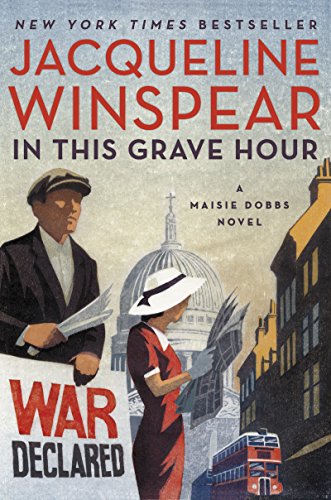
This progression changes the scale of the series without abandoning its original concerns. Espionage, national security, political extremism, aerial warfare, and intelligence work become increasingly prominent, yet Winspear continues to ask what large historical events mean at the level of individual experience. Journey to Munich, In This Grave Hour, The American Agent, and The Consequences of Fear are among the novels in which personal investigation and the wider pressures of Europe at war become especially closely entwined.
Publication order carries particular value because Maisie does not return to an unchanged starting point after each case. Her emotional life, professional role, friendships, losses, and responsibilities develop across the sequence, while recurring characters accumulate histories of their own. Individual mysteries may provide an immediate plot, but the deeper effect comes from watching years pass and earlier experiences remain active in later decisions.
The series concludes with The Comfort of Ghosts, set in London in 1945. Rather than ending at the height of wartime action, Winspear brings Maisie to a Britain confronting victory alongside homelessness, trauma, loss, and the uncertain work of reconstruction. The final novel also turns back toward unresolved elements of Maisie’s own past, giving the eighteen-book sequence a deliberate sense of return. What begins with a young woman marked by one world war ends with an older, transformed investigator facing the aftermath of another, completing a series whose real subject has always been the persistence of history in private lives.