
Below is the complete list of Ace Atkins books in order. For each series, the chronological reading order is the same as the order of publication.
Publication Order of Nick Travers Books


Publication Order of Quinn Colson Books



Publication Order of Spenser Books















Publication Order of Standalone Books



Publication Order of Akashic Noir Books


Publication Order of Jason Colson Books

Publication Order of Short Stories/Novellas Books


About Ace Atkins
Ace Atkins has built his career around Southern crime fiction, combining the investigative instincts of a former newspaper reporter with an ear for dialogue, regional character, corruption, and the uneasy relationship between crime and community. His bibliography encompasses the long-running Quinn Colson novels, the music-infused Nick Travers mysteries, historical crime fiction based on real events, contemporary thrillers, and ten authorized continuations of Robert B. Parker’s Spenser series. Mississippi, Florida, Louisiana, and the broader American South provide much of his territory, though his more recent thrillers have expanded well beyond conventional Southern noir.
Before writing novels full time, Atkins played defensive end for Auburn University, including on the undefeated 1993 Tigers team. He later entered journalism, working as a correspondent for the St. Petersburg Times and as a crime reporter for the Tampa Tribune. Reporting gave him sustained exposure to police investigations, court records, criminals, witnesses, and the stories communities construct around notorious crimes.
His first novel, Crossroad Blues, introduced Nick Travers, a former professional football player who teaches blues history at Tulane University and becomes involved in investigations connected to music and the Deep South. Travers continued through several novels mixing crime with blues culture, musicians, collectors, and the darker business surrounding the music industry.
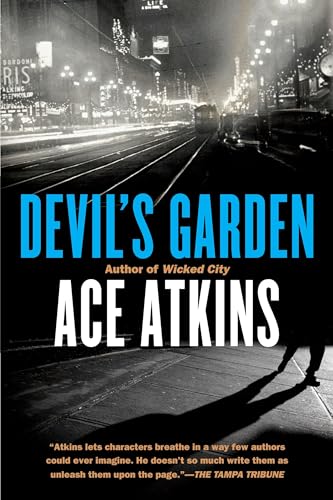
Atkins subsequently turned toward historical crimes. His investigation of the unsolved 1955 murder of Tampa underworld figure Charlie Wall had earned him a Pulitzer Prize nomination as a journalist and became the foundation for White Shadow. He followed it with Wicked City, based around corruption and violence in 1950s Phenix City, Alabama; Devil’s Garden, involving Dashiell Hammett and the scandal surrounding silent-film star Roscoe “Fatty” Arbuckle; and Infamous, which reworks the 1933 Charles Urschel kidnapping associated with gangster Machine Gun Kelly. These novels blend documented figures and events with fictional reconstruction rather than functioning as conventional histories.
Atkins found his most sustained fictional world with Quinn Colson. Beginning with The Ranger, the series follows a former Army Ranger who returns to fictional Tibbehah County, Mississippi, and eventually becomes sheriff. Organized crime, political corruption, drugs, poverty, racism, family history, and entrenched local power accumulate across the books, giving the sequence the scope of a continuing Southern community chronicle rather than a collection of isolated cases. The Ranger and The Lost Ones both received Edgar Award nominations for Best Novel.
A different challenge arrived after Robert B. Parker’s death. Atkins, a longtime admirer of Parker, was selected to continue the Spenser novels and began with Robert B. Parker’s Lullaby in 2012. Over ten books through Robert B. Parker’s Bye Bye Baby, he maintained Spenser, Hawk, Susan Silverman, and Parker’s Boston setting while bringing his own crime-writing experience to the continuation.
More recently, Atkins has returned strongly to standalone and new-series work. Don’t Let the Devil Ride follows Memphis private investigator Porter Hayes into a disappearance that develops into international intrigue, while Everybody Wants to Rule the World, published in 2025, shifts to Cold War Atlanta in 1985 for a spy thriller infused with period culture and dark humor.
Atkins lives in Oxford, Mississippi, a location well suited to fiction deeply interested in how the modern South carries its history forward. Across his novels, crime is rarely detached from place: old grudges, politics, race, music, money, and family relationships create the conditions in which violence occurs. His journalism taught him how to investigate those connections; his fiction gives him room to explore what the official record leaves unresolved.